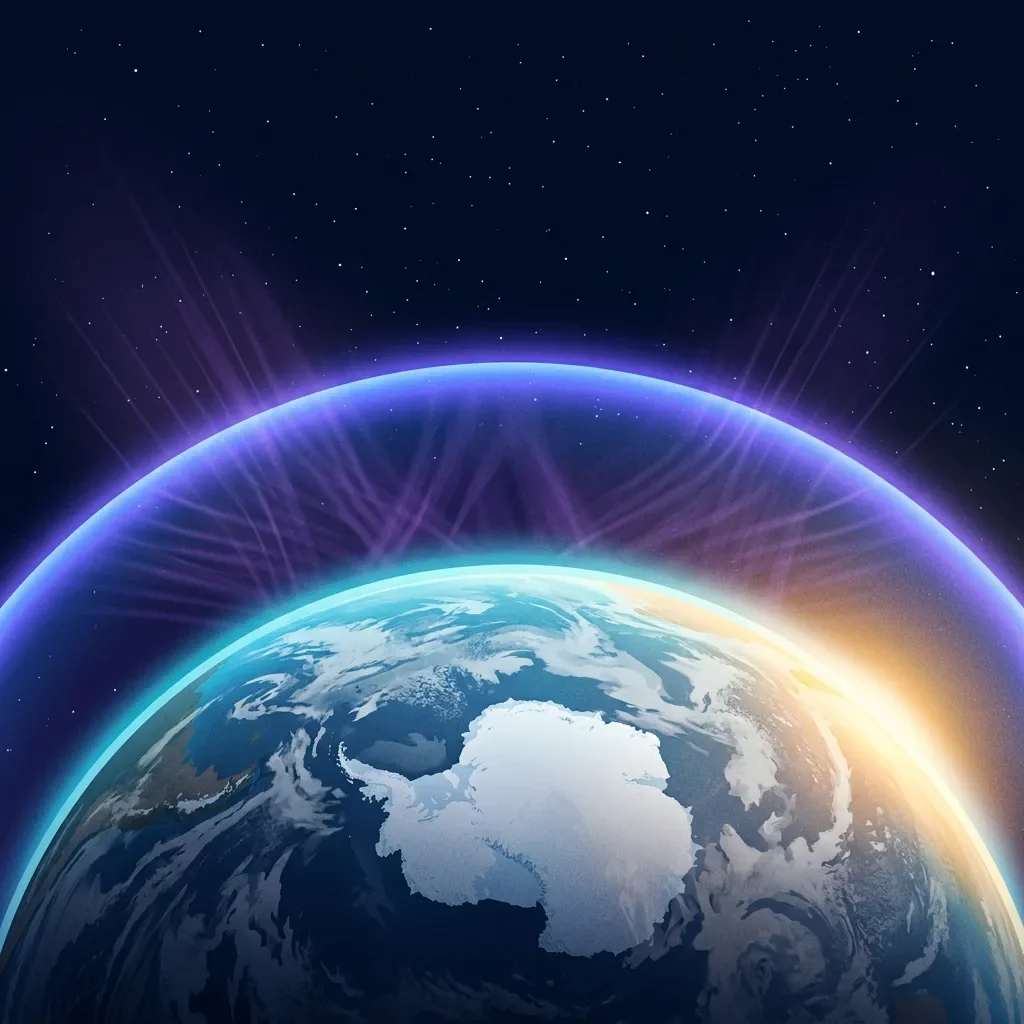
Listening practice: The sky shield that is healing1×0:007:500:00Part 1: First English listening2:39Part 2: 中文讲解与词汇提示5:14Part 3: English replay0:00NarratorBefore sunrise over Antarctica, a strange blue and purple map can appear on a scientist's screen. It does not show land, ocean, or temperature. It shows the amount of ozone high above the planet. According to NASA's Ozone Watch, satellites help monitor this thin protective gas, and the darkest colors can mark places where ozone is unusually low. The story behind that map begins with something you cannot see, but your skin, your eyes, crops, and tiny ocean life all depend on it.0:38NarratorOzone is a molecule made of three oxygen atoms. Near the ground, it can be a harmful pollutant, but in the stratosphere it acts like a sunscreen for Earth. NASA explains that this layer forms roughly eleven to fifty kilometers above the surface and absorbs much of the Sun's ultraviolet B radiation. Without enough ozone, more ultraviolet light can reach living things. That can raise the risk of sunburn, skin cancer, cataracts, reduced crop yields, and damage to aquatic plants and animals.1:15NarratorThe problem was not a real empty hole in the sky. It was a severe thinning of ozone, especially over Antarctica during spring in the Southern Hemisphere. For many years, people used chemicals called chlorofluorocarbons, or CFCs, in refrigerators, spray cans, and other products. These chemicals were useful because they were stable near the ground. But that same stability allowed them to drift upward. In the stratosphere, sunlight broke them apart and released chlorine. One chlorine atom could help destroy ozone again and again.1:56NarratorThe turning point was international cooperation. The Montreal Protocol, agreed in nineteen eighty-seven, limited the production and use of ozone-depleting substances. The United Nations Environment Programme says that nearly ninety-nine percent of banned ozone-depleting substances have been phased out. The World Meteorological Organization reports that the ozone layer remains on track to recover in coming decades, though Antarctica will take longer. This is not instant repair. It is slow chemistry, careful monitoring, and a rare example of the world changing course before a problem became permanent.2:39Coach刚才第一遍英文,主线其实很清楚:第一,臭氧层在平流层里,像地球的防晒层;第二,问题来自 CFCs 这类曾经广泛使用的化学物质;第三,南极上空的 ozone hole 不是一个真正空洞,而是臭氧严重变薄;第四,Montreal Protocol 通过全球合作限制这些物质,所以修复正在慢慢发生。3:09Coach几个高频词先抓住。ozone layer,臭氧层。stratosphere,平流层。ultraviolet radiation,紫外线辐射,文中又提到 ultraviolet B,也就是 UV-B。pollutant 是污染物,protective gas 是保护性气体。depletion 表示消耗或减少,ozone-depleting substances 就是消耗臭氧的物质。phase out 是逐步淘汰,monitor 是监测。3:45Coach再听两个重点表达。第一句:It does not show land, ocean, or temperature. It shows the amount of ozone high above the planet. 这里用 does not show A, B, or C, it shows D 做对比,提醒你地图显示的不是地面信息,而是高空臭氧数量。第二句:That same stability allowed them to drift upward. 这里 that same stability 指前一句 chemicals were stable near the ground,同一个特性既让它们有用,也让它们能升到平流层。4:25Coach最后注意几个数字的听法。nineteen eighty-seven 是一九八七年,指《蒙特利尔议定书》达成的年份。nearly ninety-nine percent 是接近百分之九十九,说明被禁的消耗臭氧物质已经大规模淘汰。eleven to fifty kilometers above the surface,是离地表大约十一到五十公里。第二遍重听时,不必追每个词,先抓住 ozone, CFCs, ultraviolet, Montreal Protocol, recover 这几个支点。5:14NarratorBefore sunrise over Antarctica, a strange blue and purple map can appear on a scientist's screen. It does not show land, ocean, or temperature. It shows the amount of ozone high above the planet. According to NASA's Ozone Watch, satellites help monitor this thin protective gas, and the darkest colors can mark places where ozone is unusually low. The story behind that map begins with something you cannot see, but your skin, your eyes, crops, and tiny ocean life all depend on it.5:51NarratorOzone is a molecule made of three oxygen atoms. Near the ground, it can be a harmful pollutant, but in the stratosphere it acts like a sunscreen for Earth. NASA explains that this layer forms roughly eleven to fifty kilometers above the surface and absorbs much of the Sun's ultraviolet B radiation. Without enough ozone, more ultraviolet light can reach living things. That can raise the risk of sunburn, skin cancer, cataracts, reduced crop yields, and damage to aquatic plants and animals.6:27NarratorThe problem was not a real empty hole in the sky. It was a severe thinning of ozone, especially over Antarctica during spring in the Southern Hemisphere. For many years, people used chemicals called chlorofluorocarbons, or CFCs, in refrigerators, spray cans, and other products. These chemicals were useful because they were stable near the ground. But that same stability allowed them to drift upward. In the stratosphere, sunlight broke them apart and released chlorine. One chlorine atom could help destroy ozone again and again.7:06NarratorThe turning point was international cooperation. The Montreal Protocol, agreed in nineteen eighty-seven, limited the production and use of ozone-depleting substances. The United Nations Environment Programme says that nearly ninety-nine percent of banned ozone-depleting substances have been phased out. The World Meteorological Organization reports that the ozone layer remains on track to recover in coming decades, though Antarctica will take longer. This is not instant repair. It is slow chemistry, careful monitoring, and a rare example of the world changing course before a problem became permanent.

Add more perspectives or context around this Post.