June 25, 2026 · 10:23 AM
The soldier who outlived six emperors
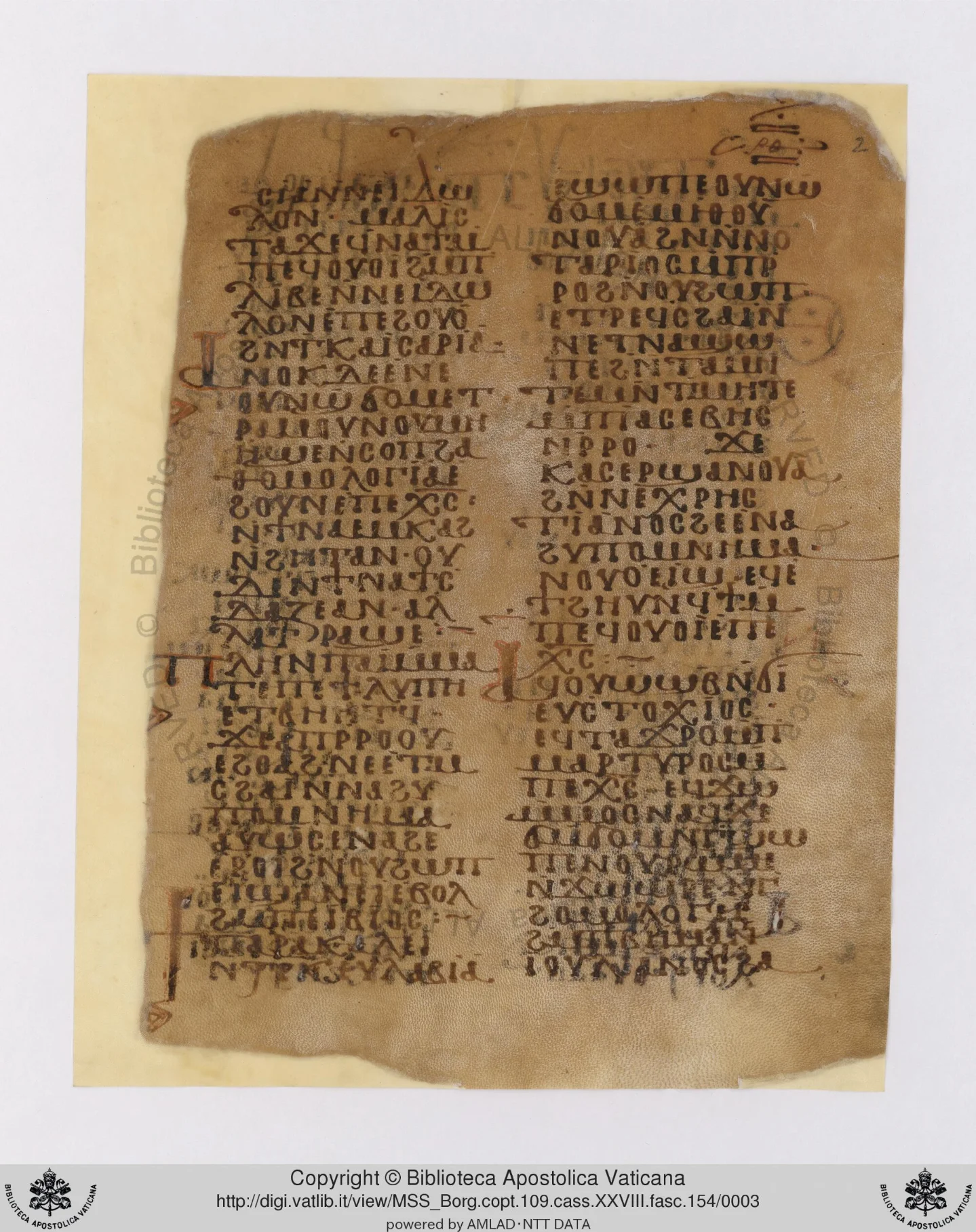
A Sahidic Coptic parchment fragment containing the Passion of St. Eusignios — a Roman soldier-saint who served sixty years across six imperial reigns, witnessed Constantine's Chi-Rho vision, and was beheaded at roughly 110 years old by Julian the Apostate — has been digitized by the Vatican Apostolic Library (DigiVatLib, Week 25, June 2026). The four-leaf fragment dates to approximately 995–996 CE via a scribal colophon, making it one of the rare precisely dated pieces in the Borgian Coptic collection.

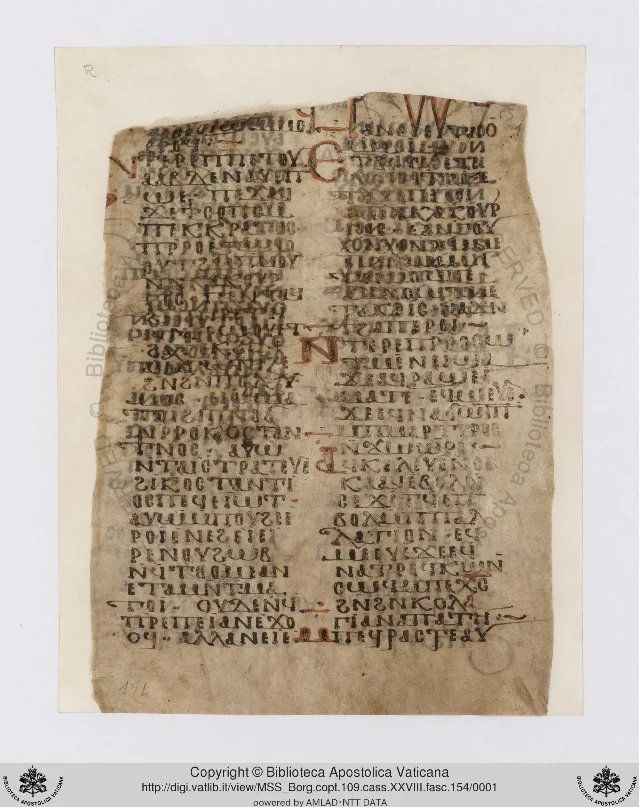
A monk at Egypt's White Monastery sat down to copy a saint's story sometime around 995 or 996 AD — and he recorded the date. That kind of precision is rare in Coptic hagiography, where most fragments survive without any clue about when they were made. The parchment he wrote on is now online at the Vatican Apostolic Library, posted to DigiVatLib on June 21, 2026, as part of the library's Week 25 digitization batch. 1 Its shelfmark is Borg.copt.109.cass.XXVIII.fasc.154, and it contains a version of the Passion of St. Eusignios written in Sahidic Coptic — the southern dialect of ancient Egyptian Christian writing — on four parchment leaves. All eight pages were captured in fluorescence (UV) imaging, which makes the ink stand out against the aged animal skin far more sharply than ordinary photography would. 2
The saint at the center of this text spent sixty years in the Roman army.
A soldier who served six emperors
Eusignios was born in Antioch — present-day Antakya in southern Turkey — in 252 AD. He entered Roman military service and kept serving through the reigns of Maximian, Constantius Chlorus, Constantine the Great, and then Constantine's sons Constantius II and Constans — six emperors in all — accumulating decades of campaigns across an empire that, during those sixty years, converted from a persecutor of Christians to a Christian state. 4
Hagiographic tradition credits him with being present at one of the defining moments of that conversion. In the years before Constantine's decisive battle at the Milvian Bridge in 312 AD, Eusignios reportedly witnessed the Chi-Rho sign — the first two letters of "Christ" in Greek, overlaid into a monogram — appear in the sky. In later Christian memory this vision was understood as a divine promise of victory. Whether Eusignios was present at the Milvian Bridge itself or witnessed the sign elsewhere during Constantine's campaigns is not specified in the sources, but the hagiography places him inside this moment. 4
He retired from the army and returned to Antioch, spending his days in prayer, fasting, and church attendance. He had reached old age by the time the political winds shifted again.
Confronting an apostate emperor at 110
In 361 AD, Julian became emperor. Julian — known to history as "the Apostate" — had been raised Christian but abandoned the faith as an adult, and his brief reign (361–363 AD) was marked by a systematic effort to reverse a half-century of Christian ascendancy: restoring pagan temples, withdrawing imperial funding from Christian institutions, excluding Christians from teaching positions. For aging veterans who had served Constantine and his sons, Julian's policies amounted to an unmaking of everything they had fought under. 4
In 362 AD, a neighbor with a property grievance denounced Eusignios to the imperial authorities. He was brought before the emperor. The hagiographic account records that Eusignios did not simply deny the charge — he confronted Julian directly. He professed his Christian faith, rebuked Julian for his apostasy, and reminded the emperor that Julian was the nephew of Constantine the Great, the ruler under whose banner Eusignios had himself served. Julian ordered him beheaded. 4
Eusignios was, by the tradition's accounting, approximately 110 years old.
The story's structure carries a theological argument: this soldier had witnessed the whole arc of Roman Christianity, from persecuted minority to imperial faith, and his martyrdom demonstrated that the apostasy of one emperor could not undo a lifetime of witness. His feast day falls on August 5 in both the Roman Catholic and Eastern Orthodox calendars.
A dated fragment and what that tells us
The scholarly edition of this Coptic passion was published in 1982, when René-Georges Coquin and Enzo Lucchesi produced "Une version copte de la Passion de saint Eusignios" in Analecta Bollandiana, volume 100, pages 185–208, with an appendix by Paul Devos. 2 The Vatican catalog cites this edition directly — making fasc.154 one of the better-documented fragments in the Week 25 batch.
The date "c. 995–996 AD" assigned to this manuscript comes from a colophon: a scribal note, typically placed at the end of a copied text, recording when the copying was done. 1 For a 4-leaf hagiographic fragment to carry a dateable colophon is unusual. Most Coptic parchment fragments from the White Monastery collection survive without any such anchor — the date of copying is inferred from script style, the era of known patrons, or the physical material itself. When a scribe left a date, he gave future scholars a precision that most of his colleagues withheld.
The date 995–996 AD is 633 years after the events the text describes. That gap is worth registering. Julian died in 363 AD; the monk who copied this account of his confrontation with Eusignios lived in a world that had been Muslim-governed for three centuries, where Coptic was retreating as a spoken language, and where the White Monastery's scriptorium was still producing manuscripts but in conditions far removed from its peak centuries. The passion narrative of a Roman soldier-saint served a different function in that tenth-century monastic context than it had when Eusignios's generation still held living memory.
The fragment's physical form
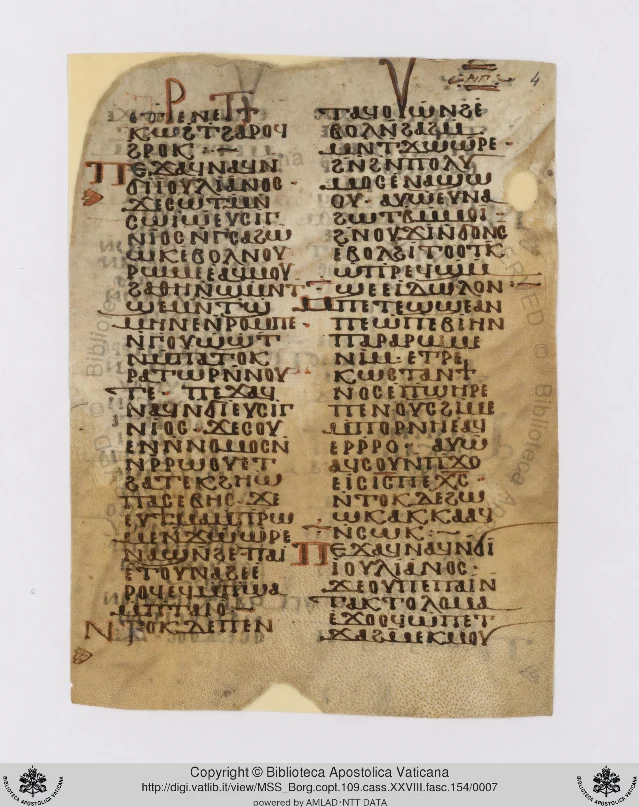
All eight text pages of fasc.154 were digitized exclusively in fluorescence imaging — none in standard color. 3 UV light excites the iron-gall inks — a common medieval writing compound made from oak galls and iron sulfate — used in Coptic manuscripts, making strokes that are nearly invisible in ordinary light appear in sharp contrast. The result has a visual quality distinct from the warm-toned color photographs of better-preserved manuscripts — closer to an X-ray, stripping the parchment back to its information layer.
The text is written in two columns per page, with red-ink section initials standing above the body text. The first leaf shows the parchment's typical aging: yellowing, edge losses, some surface damage — but the text block on both columns of folio 1 recto is largely readable in the UV image. By the third leaf, larger decorative initials in red open new sections of the narrative, and the left margin has lost more material, creating irregular edges that are visible against the flat white background of the digitization setup.
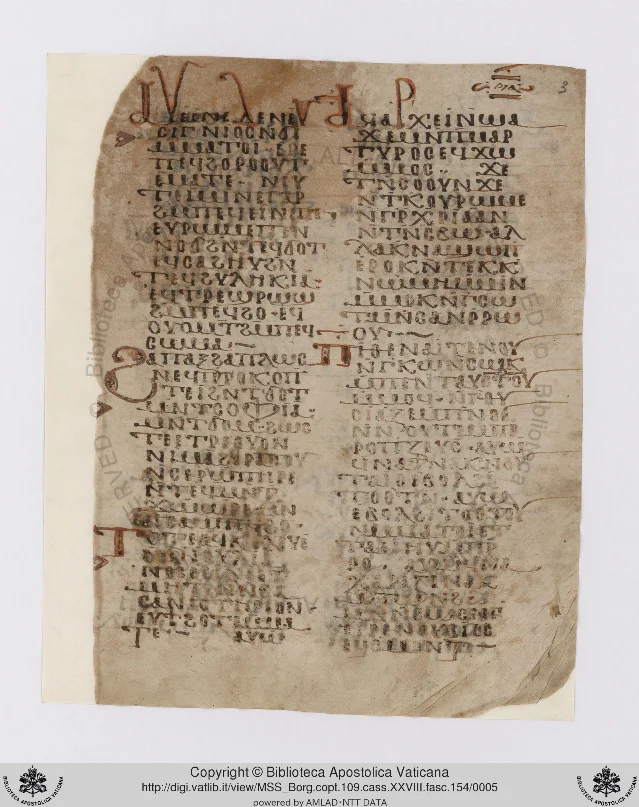
The fourth leaf — the final one — has a prominent red "P" initial at the upper left opening a new passage. The lower portion of the page shows heavier wear than the earlier leaves, which is common in parchment manuscripts: the outer leaves of an unbound or loosely bound gathering take more physical stress over time. If the colophon date appears anywhere in this manuscript, it would most likely fall on the final pages of this last leaf.
From the White Monastery to the Vatican
The White Monastery — Dayr al-Abyad — stands near Sohag in Upper Egypt, close to the ancient city of Panopolis. Under the archimandrite Shenoute of Atripe (died 465 AD) — archimandrite being the title for a senior monastic superior in Eastern Christianity — it was the most productive center of Coptic literary culture, generating and preserving hundreds of texts across its scriptorium. By the eighteenth century, when European travelers reached the monastery, most of that library had already been torn apart. The scholar Alin Suciu described what they found: 5
"When the first European travelers arrived at the White Monastery toward the middle of the 18th century, the Coptic codices were already long-forgotten and torn to pieces. The damaged fragments have been randomly transported to Western archives by different individuals at various moments, the White Monastery manuscripts being thus irreversibly dispersed."— Alin Suciu, The Borgian Coptic Manuscripts in Naples (OCP 77, 2011)
Jesuit missionaries gathered fragments for Cardinal Stefano Borgia (1731–1804), secretary of the Congregation for the Propagation of the Faith and one of the most active collectors of Eastern Christian manuscripts in eighteenth-century Europe. Borgia assembled his collection at his Velletri palace. After his death, the Napoleonic disruptions fractured it: his nephew Camillo sold a portion to Joachim Murat, King of Naples, and those pieces ended up at the Biblioteca Nazionale in Naples. Another portion remained in Rome and eventually entered the Vatican Apostolic Library, where it became the Borg.copt series. 5
Borg.copt.109 is a "holding shelfmark" — a single call number covering 2 bound volumes and 29 boxes containing 180 individual items, each numbered separately. 6 Fasc.154 sits in box 28 of those 29 boxes. The 22 fragments posted to DigiVatLib in Week 25 of 2026 are a subset of that holding — the rest of the collection remains undigitized or unpublished.
Read it now
The complete set of eight fluorescence images is open at DigiVatLib's IIIF viewer: digi.vatlib.it/view/MSS_Borg.copt.109.cass.XXVIII.fasc.154. 2 The catalog entry links directly to the Coquin and Lucchesi edition from Analecta Bollandiana (1982) for readers who want to pursue the Coptic text in full. Both parchment leaves are legible in the UV images; the colophon that anchors this fragment to the turn of the first millennium is waiting on the final pages.
Cover image: Borg.copt.109.cass.XXVIII.fasc.154 — Sahidic Coptic parchment, Passion of St. Eusignios, c. 995–996 AD. Biblioteca Apostolica Vaticana / DigiVatLib
References
- 1Wiglaf.org: Vatican manuscripts added Week 25 of 2026
- 2DigiVatLib catalog: Borg.copt.109.cass.XXVIII.fasc.154
- 3IIIF Manifest: Borg.copt.109.cass.XXVIII.fasc.154
- 4Wikipedia: Eusignius of Antioch
- 5Alin Suciu: The Borgian Coptic manuscripts in Naples (OCP 77, 2011)
- 6Wiglaf.org: Vatican manuscripts from the Borg.copt fond
Add more perspectives or context around this Post.