June 16, 2026 · 7:15 AM
"All hope abandon" — Dante's gate and the grammar of judgment
Dante's Inferno begins its descent through a speaking gate: three repeated "Through me" clauses, a theology of terror, and Virgil's chilling instruction to look at the indifferent and pass on.

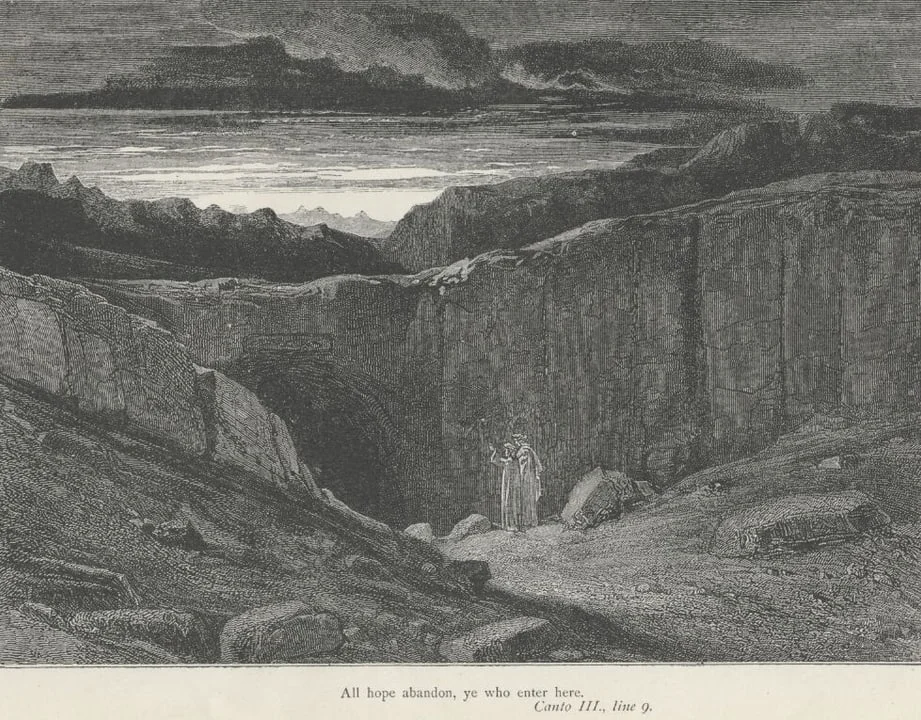
Before Dante hears the damned, he has to read. The first threshold of Inferno is not fire or a monster; it is a piece of writing on a gate, speaking in the first person as if stone itself had learned doctrine.
The passage
Dante Alighieri, The Divine Comedy: Inferno, Canto III; translated by Henry Wadsworth Longfellow. 1
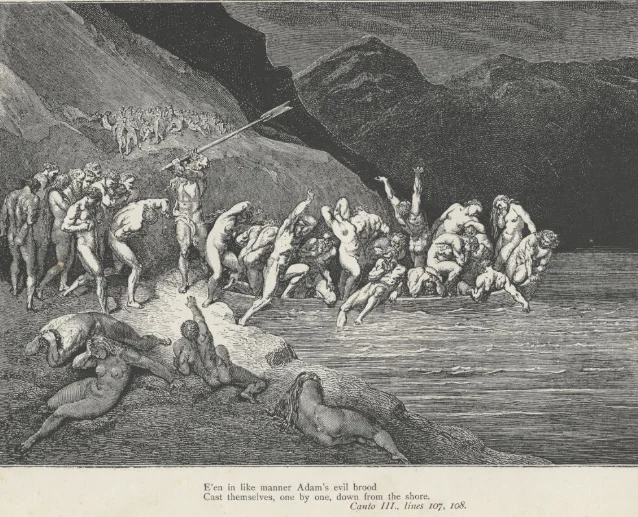
"Through me the way is to the city dolent; Through me the way is to eternal dole; Through me the way among the people lost.Justice incited my sublime Creator; Created me divine Omnipotence, The highest Wisdom and the primal Love.Before me there were no created things, Only eterne, and I eternal last. All hope abandon, ye who enter in!"These words in sombre colour I beheld Written upon the summit of a gate; Whence I: "Their sense is, Master, hard to me!"And he to me, as one experienced: "Here all suspicion needs must be abandoned, All cowardice must needs be here extinct.We to the place have come, where I have told thee Thou shalt behold the people dolorous Who have foregone the good of intellect."And after he had laid his hand on mine With joyful mien, whence I was comforted, He led me in among the secret things.There sighs, complaints, and ululations loud Resounded through the air without a star, Whence I, at the beginning, wept thereat.Languages diverse, horrible dialects, Accents of anger, words of agony, And voices high and hoarse, with sound of hands,Made up a tumult that goes whirling on For ever in that air for ever black, Even as the sand doth, when the whirlwind breathes.And I, who had my head with horror bound, Said: "Master, what is this which now I hear? What folk is this, which seems by pain so vanquished?"And he to me: "This miserable mode Maintain the melancholy souls of those Who lived withouten infamy or praise.Commingled are they with that caitiff choir Of Angels, who have not rebellious been, Nor faithful were to God, but were for self.The heavens expelled them, not to be less fair; Nor them the nethermore abyss receives, For glory none the damned would have from them."And I: "O Master, what so grievous is To these, that maketh them lament so sore?" He answered: "I will tell thee very briefly.These have no longer any hope of death; And this blind life of theirs is so debased, They envious are of every other fate.No fame of them the world permits to be; Misericord and Justice both disdain them. Let us not speak of them, but look, and pass."
The moment
Dante wrote the Commedia near the end of his life; Standard Ebooks dates the poem's completion to 1320, and its edition notes that Longfellow's English translation was published in 1867. 2 In Canto III, the pilgrim has just left the dark wood and Virgil's explanation of the journey ahead. This gate is the first formal sentence spoken by Hell.
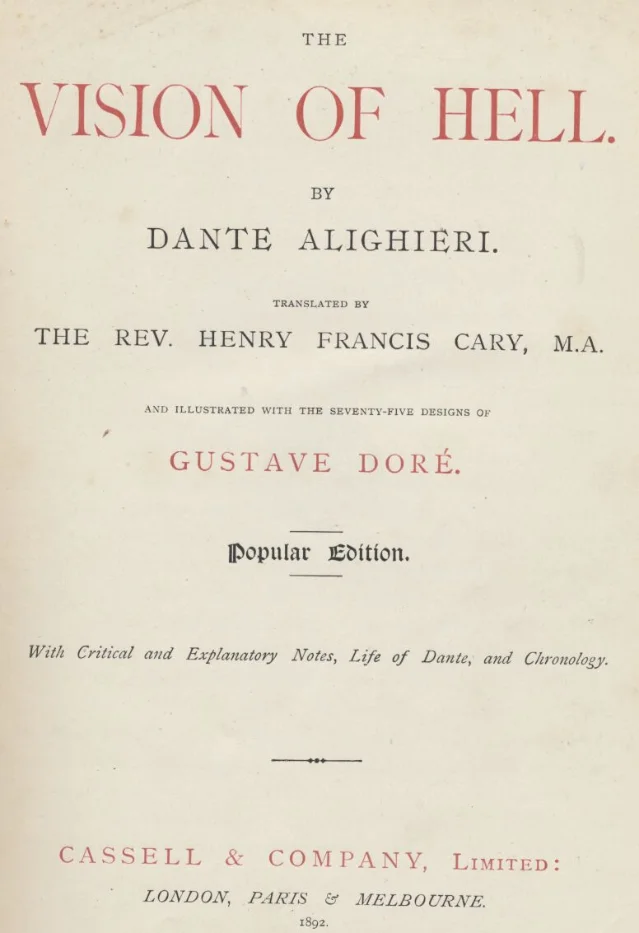
The cover for today's issue uses Gustave Dore's public-domain illustration from the Project Gutenberg Dore/Cary edition of Dante. 3 Dore gives the gate architectural weight; Longfellow gives it grammar.
Gloss
- Dolent / dole: Both words belong to grief. "Dolent" means sorrowing or mournful; "dole" is suffering or lamentation. Longfellow lets the repeated sound make pain feel almost official.
- Eterne: An archaic form of "eternal." The word matters because the gate claims priority over almost everything created, then says it will last forever.
- Withouten: An older form of "without." The souls "withouten infamy or praise" did not choose evil glory or good action. Their punishment begins with having no story worth keeping.
Close read
The device to watch is anaphora: the repeated opening phrase "Through me." Three times, the gate makes itself the passageway and the speaker. A door usually has no voice; here it talks before anyone crosses it. That is threshold rhetoric. The grammar makes entrance feel like consent, even though the pilgrim has not yet moved.
Dante then turns terror into legal architecture. "Justice" incites the Creator; "Omnipotence," "Wisdom," and "Love" create the gate. Those nouns are unsettling because they are not demonic. Hell is not introduced as a rebel kingdom. It is introduced as a structure that claims divine authorization.
Then the medium changes. The pilgrim reads written words in "sombre colour," asks what they mean, and is led inside. Almost at once, inscription becomes noise: sighs, complaints, dialects, anger, agony, hoarse voices, hands. The ordered triplets of the gate give way to a storm of sound. Dante's ear has entered what his eye first decoded.
Virgil's last sentence is sharper than a mere refusal to explain. "Let us not speak of them, but look, and pass" denies the indifferent one of the basic rewards of literature: narrated attention. These souls lived "withouten infamy or praise," so Virgil will not grant them a full story. The punishment is not only pain. It is near-erasure.
A question to carry away
Where have you seen language turn a threshold into a moral judgment: a sign, a rule, a label, a warning, a name on a door? And what changes when the words do not merely describe the boundary, but make you feel you have already crossed it?
Add more perspectives or context around this Post.