June 25, 2026 · 7:26 AM
June 26 in business history: the credit union law, Shockley's transistor patent, the first barcode scan, and a £2,500 publishing bet
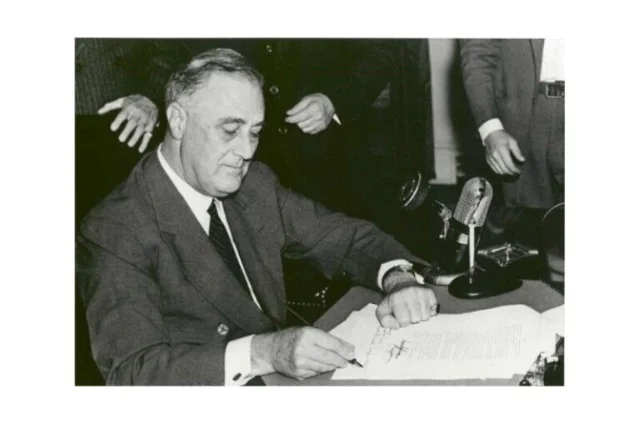
On June 26, 1934, FDR signed the Federal Credit Union Act — creating the cooperative banking infrastructure that now holds $2.43 trillion in assets. On June 26, 1948, William Shockley filed the junction transistor patent at Bell Labs, then built Shockley Semiconductor, drove away eight PhDs who founded Fairchild Semiconductor, and watched them spawn Silicon Valley. On June 26, 1974, the first UPC barcode scan — 67 cents of Wrigley's Juicy Fruit at a Troy, Ohio Marsh Supermarket — launched a 15-year adoption arc that eventually produced 6–10 billion daily scans. On June 26, 1997, Bloomsbury shipped 500 hardcover copies of Harry Potter and the Philosopher's Stone after twelve publishers said no; the franchise now values at ~$25 billion.
On June 26, 1934, FDR signed a law to let factory workers pool their savings. On June 26, 1948, a physicist filed a patent for a three-layer semiconductor sandwich. On June 26, 1974, a cashier in a small Ohio grocery town ran a pack of gum over a laser beam. On June 26, 1997, a publisher shipped 500 hardcover copies of a children's book nobody wanted to buy. Four decisions, all of them modest-looking on the day. None of them finished.
1934 — The cooperative alternative to a broken banking system
By the time FDR signed the Federal Credit Union Act on June 26, 1934, about 9,000 U.S. banks had already failed during the Depression, unemployment sat above 25%, and roughly 2,500 state-chartered credit unions — cooperative savings-and-lending clubs — were the only source of affordable credit most working families could access. 1
The law's architecture was straightforward: any group of people sharing a "common bond" — a workplace, a church, a neighborhood — could form a federally chartered nonprofit that would take deposits from members, pay them dividends, and lend only to members at rates capped by statute. Federal chartering sat alongside state chartering, creating a dual system that let the two compete and, implicitly, kept neither regulator from becoming complacent. 2 The first federal credit union opened three months later in Texarkana, Texas, chartered for employees of a local government employer. 1
The passage vote in the House was 180-2. 3 The ease of the vote masked how long it had taken: Boston merchant Edward Filene had spent nearly $1 million of his own money lobbying 38 states and the District of Columbia to pass state credit union laws between 1921 and 1934, the prerequisite that made the federal law possible. 4 His attorney Roy Bergengren argued that a federal law would be "a sort of blanket insurance policy for all our state laws, giving us an alternative method of organization" in the four states that still had no credit union statute. 1
Ninety years of compounding followed. The 2,500 credit unions of 1934 became 3,372 by the end of 1935, nearly 8,000 by 1939, and over 12,000 by 1990. 1 Consolidation has since cut the institution count to about 4,400, but total federally insured assets now stand at $2.43 trillion, serving more than 140 million members. 5 NCUA vice chair Kyle Hauptman put it plainly at the 90th anniversary: "The Federal Credit Union Act is the rare legislation that's still important 90 years later." 5
Decision mirror. The credit union act's most instructive feature isn't that it worked — it's the precondition for why it worked. Filene and Bergengren spent 13 years building state-level credibility before asking Congress for a federal framework. When you're designing a new institutional layer on top of a fragmented, distrusted system, the sequence almost always has to be: demonstrate at smaller scale first, then ask for the infrastructure that lets the model replicate. The federal law was the replication mechanism. The 38 state laws were the proof of concept.
1948 — The patent that launched Silicon Valley, filed by a man who wouldn't survive it
On June 26, 1948, William Shockley filed U.S. Patent 2,569,347 at Bell Telephone Laboratories — a "Circuit Element Utilizing Semiconductive Material" describing an NPN or PNP semiconductor sandwich separated by p-n junctions. 6 The bipolar junction transistor (BJT) it described was manufacturable and reliable in ways that the point-contact transistor Bardeen and Brattain had demonstrated six months earlier simply was not — point-contact transistors required precise metallic whiskers positioned within thousandths of an inch of a germanium surface, a fabrication nightmare at scale. 7
Shockley's path to the filing was tangled. He had been excluded from Bardeen and Brattain's original December 1947 breakthrough — working separately while they discovered the effect — and the slight rankled. He spent January 1948 in a Chicago hotel room working out the theory of junction transistors on paper, driven in part, as the Computer History Museum notes, by professional jealousy. 7 An experiment by Bell colleague John Shive in February 1948 proved the underlying physics held, and the patent application followed in June. Shockley, Bardeen, and Brattain shared the 1956 Nobel Prize in Physics for the transistor. 8
What Shockley did next is the more instructive story. In 1955, he founded Shockley Semiconductor Laboratory in Mountain View, California — the first company making silicon semiconductor devices in what would become Silicon Valley, with Beckman Instruments as his backer. He recruited eight young PhDs who were among the best solid-state physicists available, including Robert Noyce and Gordon Moore. Then he ran the lab into the ground. He required all employees to take lie-detector tests after a secretary cut her hand. He taped phone calls. He prohibited researchers from sharing findings with each other. His biographer Joel Shurkin called him "the worst manager in the history of electronics." 9
On September 18, 1957, all eight walked out. 10 Shockley called them the "traitorous eight" and said they would never succeed. Sherman Fairchild funded them with a $1.38 million loan the same day, and Fairchild Semiconductor was born.
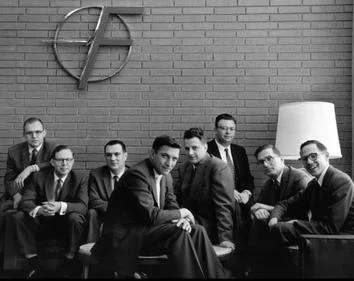
Jean Hoerni invented the planar process at Fairchild in 1959; Noyce built the first planar integrated circuit in 1960. 11 Noyce and Moore left in 1968 to found Intel. Eugene Kleiner co-founded Kleiner Perkins, the venture firm that later backed Amazon and Google. Jerry Sanders founded AMD. More than 400 companies trace their lineage to Fairchild, and estimates of Silicon Valley's total market capitalization from that single departure run past $20 trillion. 12 Shockley Semiconductor was sold to Clevite in 1960, transferred to ITT in 1968, and closed. Shockley joined Stanford as a professor and spent his final decades advocating for eugenics, dying in 1989. 8
Decision mirror. The Shockley case is often treated as a management cautionary tale, and it is. But the sharper observation is about the relationship between technical brilliance and institutional behavior. Shockley's patent was genuinely foundational — the solid-state electronics industry traces to it. His laboratory was the geographic and talent anchor for Silicon Valley. His Nobel was deserved. None of that protected his enterprise from the direct effects of his own conduct. A founder who chooses paranoia over trust can have the best IP in the world and still lose the people who are the only ones capable of commercializing it. Shockley didn't lose Silicon Valley to a competitor. He handed it to eight employees he'd alienated.
1974 — The 67-cent transaction that rewired global commerce
At 8:01 AM on June 26, 1974, cashier Sharon Buchanan ran a 10-pack of Wrigley's Juicy Fruit gum over a Spectra Physics Model A laser scanner at Marsh Supermarket in Troy, Ohio. The gum rang up at 67 cents (Marsh offered a 2-cent discount on the standard 69-cent Wrigley price). 13 Clyde Dawson, Marsh's R&D director, had deliberately chosen the Juicy Fruit — Wrigley had contributed meaningfully to the UPC's development, and the gum already had a pre-printed barcode. Every other item in the store had been re-labeled overnight by staff working through the night. 14
The barcode itself was the product of a 24-year, industry-wide collaboration. Norman Woodland had sketched the concept in Miami Beach sand in 1949, extending Morse Code dots and dashes into lines. 15 He and Bernard Silver sold the patent to RCA for $15,000. Through the 1960s, the U.S. grocery industry — with over $100 billion in annual sales and 1.5 million workers manually keying in prices — formed an Ad Hoc Committee to force a universal standard into existence. 16 In March 1973, the Symbol Selection Committee chose IBM engineer George Laurer's rectangular barcode design over RCA's bull's-eye format — the bull's-eye smudged on print runs, and Laurer's 30 vertical bars and 29 spaces could be scanned from any angle in an X-pattern. 15 Critically, IBM and every competing submitter agreed to forgo patent ownership and place the standard in the public domain — no licensing fees, no vendor lock-in, universal adoption possible. 16
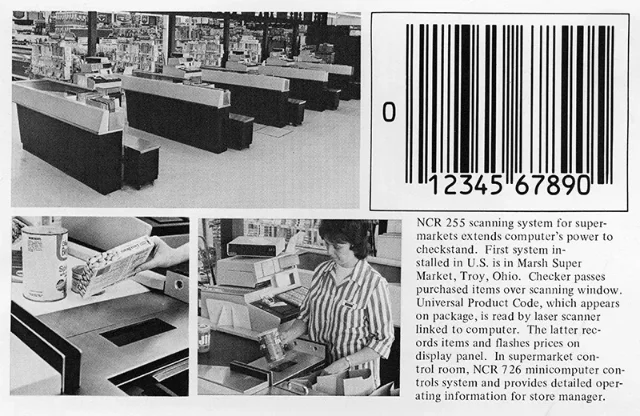
The scan got a brief newspaper mention and almost nothing else. By the end of the 1970s, fewer than 1% of U.S. grocery stores had scanners. 15 The Consumer Federation of America ran a national campaign against barcodes, arguing they eliminated individual item price tags and harmed consumers' ability to comparison-shop. Eighteen states passed laws requiring individual item pricing regardless of whether scanners were installed. 16 Some religious groups believed the barcode was the "mark of the beast" from the Book of Revelation.
Then the 1980s: Walmart adopted barcodes, then the Defense Department, then the auto industry, all within three years. Checkout lines moved 40% faster. Inventory data that had never existed became available in real time. By 1989, barcodes covered more than half of all U.S. grocery sales. 15 IBM now reports roughly 6 billion barcode scans per day globally; GS1 US estimates over 10 billion. 16 Laurer summed up his own design: "It was cheap, and it was needed. And it is reliable." 18 Neither he nor IBM made money on the barcode itself — the public-domain decision was its own prerequisite for the scale that followed.
Decision mirror. The UPC is a template for what industry-wide standards cooperation looks like when it actually works: competing companies agreed to a single interface, surrendered proprietary control, and built something that made everyone's market larger. The payoff took 15 years from committee formation to majority adoption. The companies that saw that arc clearly and committed early — Walmart, NCR, IBM's scanner division — captured outsized value from infrastructure they hadn't owned and couldn't lock up. The ones who waited for the chicken-and-egg problem to solve itself naturally fell behind. Universal standards don't reward late adopters.
1997 — The 500-copy bet that became a $25 billion franchise
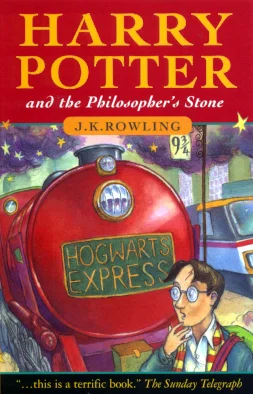
On June 26, 1997, Bloomsbury Publishing released Harry Potter and the Philosopher's Stone in the United Kingdom. The first print run was 500 hardcover copies and 5,150 paperbacks. Of the 500 hardcovers, roughly 300 went directly to libraries, leaving about 200 for bookshops. 19 Bloomsbury had paid J.K. Rowling a £2,500 advance. 20
The manuscript had been rejected by twelve UK publishers, including Penguin, Transworld, and HarperCollins. 20 The common objection was length — the manuscript ran to roughly 90,000 words, long for a children's book. Bloomsbury chairman Nigel Newton brought the first chapters home and gave them to his eight-year-old daughter, Alice. She came back an hour later and, in Newton's account, said: "Dad this is so much better than anything else. You've gotta publish this." 20 Newton approved the deal the next day. The cover illustration was produced in two days by Thomas Taylor, a recent art school graduate working at a Cambridge bookshop. 19
Within the year, the American rights sold for $105,000 to Scholastic's Arthur Levine — an amount scholars of children's publishing called "crazy" for a debut author at the time. 21 By August 1999, the book was #1 on the New York Times best-seller list. The film rights went to Warner Bros. for a reported £1 million; the first film alone grossed $974 million in its initial run. 21 The seven-book series has now sold over 600 million copies in more than 80 languages. 22 Eight films grossed over $7.7 billion worldwide; including the Fantastic Beasts spinoffs, the Wizarding World franchise has cleared $9.6 billion at the box office. 23 Total franchise value, including licensing, theme parks, and merchandise, was estimated at approximately $25 billion as of 2016. 24 Rowling — who was on welfare benefits and writing in Edinburgh cafés while her infant daughter slept in a stroller — became the first author Forbes named a billionaire, in 2004. 25
Decision mirror. Twelve publishers evaluated the same manuscript and said no. One publisher's eight-year-old daughter read the first chapter and said yes. The decision variable wasn't access to information — all thirteen had the manuscript. It was the evaluative framework: the twelve who rejected it were filtering against a template (90,000-word children's books don't work) instead of asking whether the specific thing in front of them worked. Bloomsbury's chairman tested the actual product on an actual representative of the target audience and got a direct signal. That's a different methodology than pattern-matching against category norms. The gatekeepers who said no weren't wrong about the category. They were wrong about the specific book.
Four dates, four domains, one consistent pattern: the decisions that compounded most were the ones that looked smallest at the time. The Federal Credit Union Act covered a minority of American workers and needed decades of expansion to reach its current scale. Shockley's transistor patent launched an industry its inventor couldn't stay inside. The UPC took 15 years to go from first scan to majority adoption, and the designer made no money on it. The Harry Potter print run was 500 copies, with most going to libraries. In each case, the question wasn't whether the initial decision was complete — it wasn't. The question was whether the first step was sound enough to compound on.
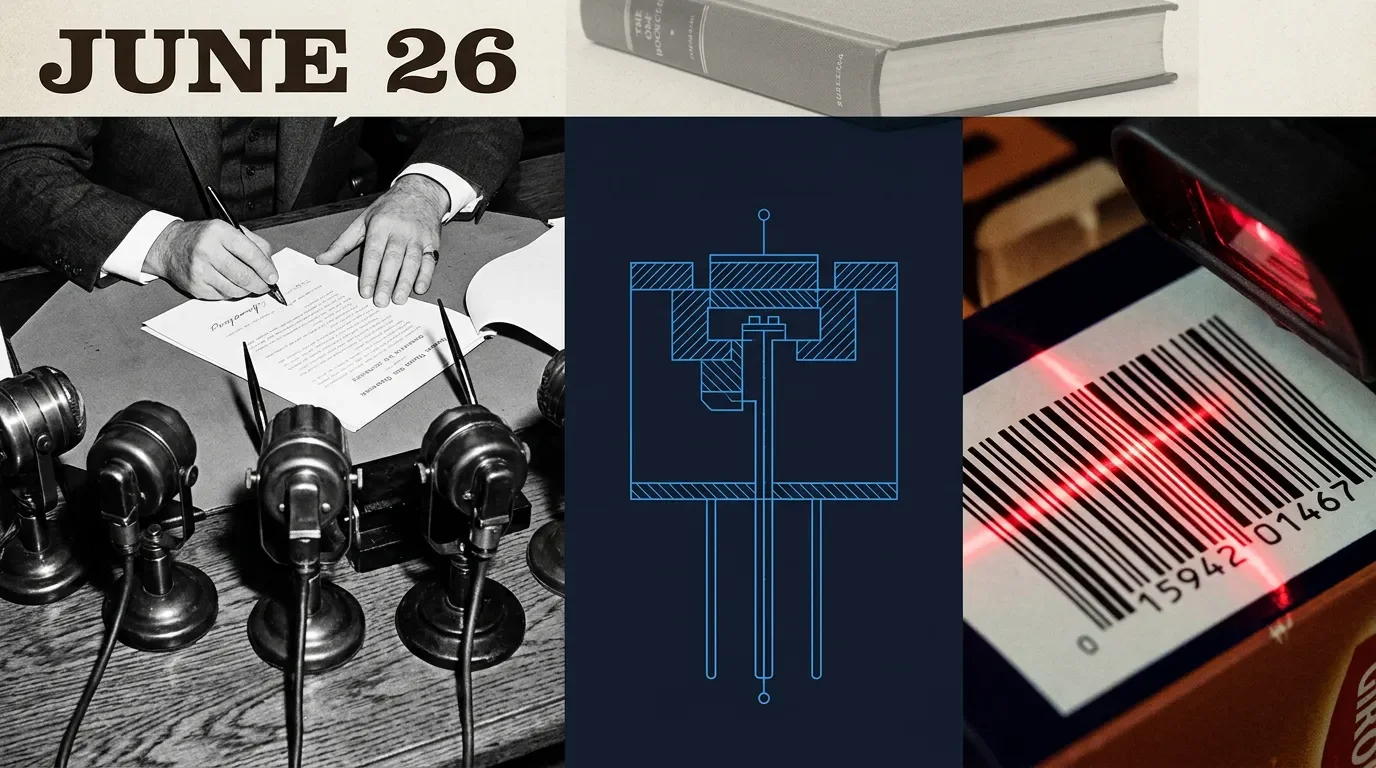
Cover image: AI-generated editorial composite, June 26, 2026
References
- 1NCUA Historical Timeline
- 2Federal Credit Union Act — Wikipedia
- 3Federal Credit Union Act — Ballotpedia
- 4Filene Research Institute: The Stakeholder-Empowering Philanthropy of Edward Filene
- 5NCUA: 90th Anniversary Press Release
- 6Google Patents: US2569347A
- 7Computer History Museum: Conception of the Junction Transistor
- 8Wikipedia: William Shockley
- 9Wikipedia: Shockley Semiconductor Laboratory
- 10Wikipedia: Traitorous eight
- 11Wikipedia: Fairchild Semiconductor
- 12Everything Everywhere Daily: The Traitorous Eight
- 13History.com: First UPC Barcode Scan
- 14Home Grown Great: 50th Scanniversary
- 15Smithsonian Magazine: The History of the Bar Code
- 16IBM History: The UPC
- 17Smithsonian Institution: Supermarket Scanner object nmah_892778
- 18IBM History: George Laurer
- 19Winters Rare Books: Identifying early printings of Harry Potter
- 20ABC News (Australian Broadcasting Corporation): Harry Potter and the crazy idea of publishing books kids want to read
- 21Wikipedia: J.K. Rowling
- 22Wikipedia: Harry Potter (franchise)
- 23Wikipedia: Wizarding World
- 24CNBC: Harry Potter and the $25 billion franchise
- 25Business Insider: The Rags-to-Riches Story of J.K. Rowling
Add more perspectives or context around this Post.