June 26, 2026 · 8:08 AM
YouTube's Gemini ad tools are for briefing creators, not replacing them
Google's new Gemini-powered YouTube ad tools bring trend data, Brand Pulse metrics, creator insights, and Demand Gen creative tips closer to campaign planning. This article explains which small brands should test them, where access is limited, and how to run a 30-minute creator-brief pilot.
Google's June 23 YouTube announcement is easy to misread as another AI ad-writing update. It is more useful than that, and also narrower: Google is putting Gemini closer to the research layer for YouTube campaigns, where brands decide which trends, creators, and visual ideas are worth testing before money is spent. 1
For a small brand owner, the question is not "Can Gemini make my YouTube strategy?" The better question is: can this reduce the number of weak creator briefs, generic Demand Gen assets, and creator shortlists built from vibes?
What changed
Google announced four YouTube ad-planning updates at Cannes Lions 2026: deeper U.S. trend data inside Google Ads Insights Finder, selected Brand Pulse metrics inside Insights Finder, a new Content & Creator Insights API for partners, and upcoming Gemini tips for Demand Gen creative on YouTube. 1
| Update | What it gives a brand owner | Practical read |
|---|---|---|
| Deeper YouTube trend data in Insights Finder | A more granular view of what is popular on YouTube in the U.S. right now. 1 | Use it before writing a creator brief, not after the video has already been shot. |
| Brand Pulse metrics in Insights Finder | A combined view of selected paid and organic brand-presence signals on YouTube. 1 | Better for brands that already have paid activity, creator mentions, or organic YouTube presence. |
| Content & Creator Insights API | Richer creator and audience information for agencies and partners planning media. 1 | Most useful if your team works through an agency, creator platform, or internal tooling. |
| Gemini Demand Gen creative tips | Coming guidance on YouTube Demand Gen campaigns, including visual recommendations meant to improve performance. 1 | Treat this as a creative QA layer, not a replacement for brand judgment. |
Why this matters for creator-led brands
The real shift is upstream. A lot of creator marketing work still starts with a loose brief: "make it authentic," "talk to Gen Z," "show the product in use." That is not a strategy. It is a hope that the creator will fill the gaps.
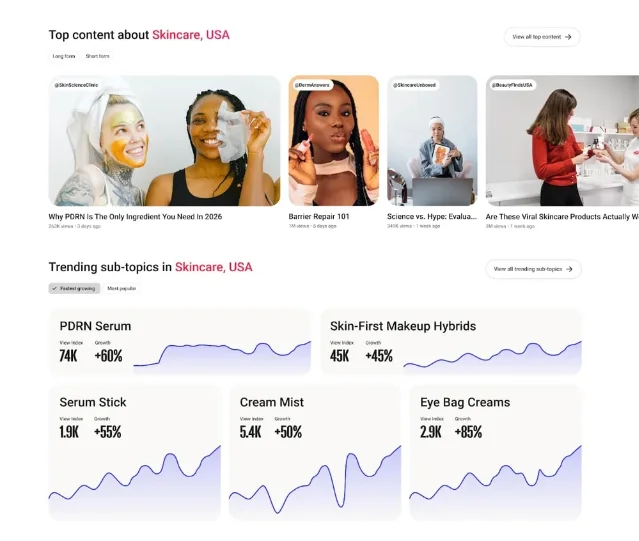
Insights Finder already lets advertisers explore audience interests, search trends, YouTube content, and ways to take action through exports and Google Ads audience paths. 2 Adding YouTube trend signals gives brand teams a stronger starting point for the brief: which sub-topics are rising, which content formats seem active, and where the brand might have a credible angle.
Brand Pulse adds a second angle. Google says the report uses multimodal AI to detect brand presence across YouTube through visuals, such as logos and product shots, and language, such as audio and video titles. 3 It also includes metrics such as Total Unique Viewers and % Share of Watch Time to help compare a brand's presence with its category. 3
That is useful because creator campaigns often fail in the handoff between organic influence and paid distribution. A creator video may generate comments, searches, or second-order mentions, but the brand team only sees the paid dashboard. Brand Pulse is Google's attempt to bring paid and organic YouTube evidence into one planning view.
The 30-minute pilot for a small brand
If you have Google Ads access and a product category with YouTube demand, test the update with one narrow campaign idea. Do not start with a full creator program.
- Pick one buying moment. Choose a situation your buyer already searches or watches for: "acne-safe sunscreen for humid weather," "home office desk setup," "AI thumbnail workflow," or another specific use case.
- Search the topic in Insights Finder. Look for audience interests, search trend movement, and YouTube content patterns rather than broad category labels. Insights Finder is built for audience interests, trends, content, and action paths. 2
- Turn the finding into a creator brief. Write one sentence that connects the trend to your product's role. Example: "Show how a creator plans three short-form video hooks from one long-form YouTube review, then compare which hook gets saved for paid testing."
- Score creator fit before outreach. If your agency or partner has access to the Content & Creator Insights API, ask for creator audience fit and content-pattern evidence instead of a vanity shortlist. 1
- Use Gemini's Demand Gen tips as a second pass. When the feature is available, compare its visual recommendations with your brand rules, product claims, and landing-page promise. Keep what improves clarity; reject what makes the asset look like everyone else's ad.
The output of this pilot should be small: one trend-backed brief, three creator angles, and one Demand Gen creative test. If you cannot produce those in 30 minutes, the tool is probably surfacing too much noise or your topic is still too broad.
Where to be careful
First, access will not be even. The June 23 announcement says the new trend insights are in the U.S., the API is for agencies and partners, and Gemini Demand Gen tips are coming soon. 1 Social Media Today also reported that Insights Finder is still in beta testing and not available to every advertiser. 4 If you run a small brand outside the U.S. or without an agency relationship, the most advanced parts may arrive later.
Second, trends can make briefs worse if the brand lacks a point of view. A rising skincare topic does not mean every skincare brand should make the same video. The useful step is to ask: what can we credibly add, prove, demonstrate, or challenge?
Third, the creator stack is getting more centralized. Earlier in 2026, YouTube said Creator Partnerships, formerly BrandConnect, was being integrated into YouTube Studio for creators and Google Ads and Display & Video 360 for advertisers. 5 YouTube also said advertisers would be able to access more than 3 million creators in the YouTube Partner Program through that system. 5 That scale helps discovery, but it also pushes brands toward platform-mediated decisions. Keep your own creator notes, post-campaign learnings, claim rules, and audience objections outside the ad platform too.
Try, wait, or skip
Try it now if YouTube is already part of your paid or creator plan, you sell into a category with active how-to or review behavior, and you can turn a trend insight into one testable brief this week.
Wait if you are organic-only, outside the current access path, or still lack a clear product claim. Better YouTube data will not fix a vague offer.
Skip for now if your brand has no video proof, no creator collaboration process, and no budget for Demand Gen tests. Start by making one strong product demonstration or customer-proof video. Then come back to the AI planning layer.
The useful version of these tools is not "AI makes the campaign." It is "AI shortens the messy research before the brief." For digital brand owners, that is still a real gain, as long as the final creative judgment stays human.

Add more perspectives or context around this Post.