
June 18, 2026 · 7:14 AM
"The voice of the sea speaks to the soul" — Chopin's grammar of awakening
A close read of Chapter VI of Kate Chopin's The Awakening: how personification, light imagery, and the sea's shifting verbs turn self-knowledge into something physical.

Kate Chopin makes awakening sound less like an idea than a weather change in the body. The passage below comes from Chapter VI of The Awakening, first published in 1899; Project Gutenberg's edition identifies the work as public domain in the United States, while the Internet Archive scan records the 1899 H. S. Stone & Company edition. 1 2
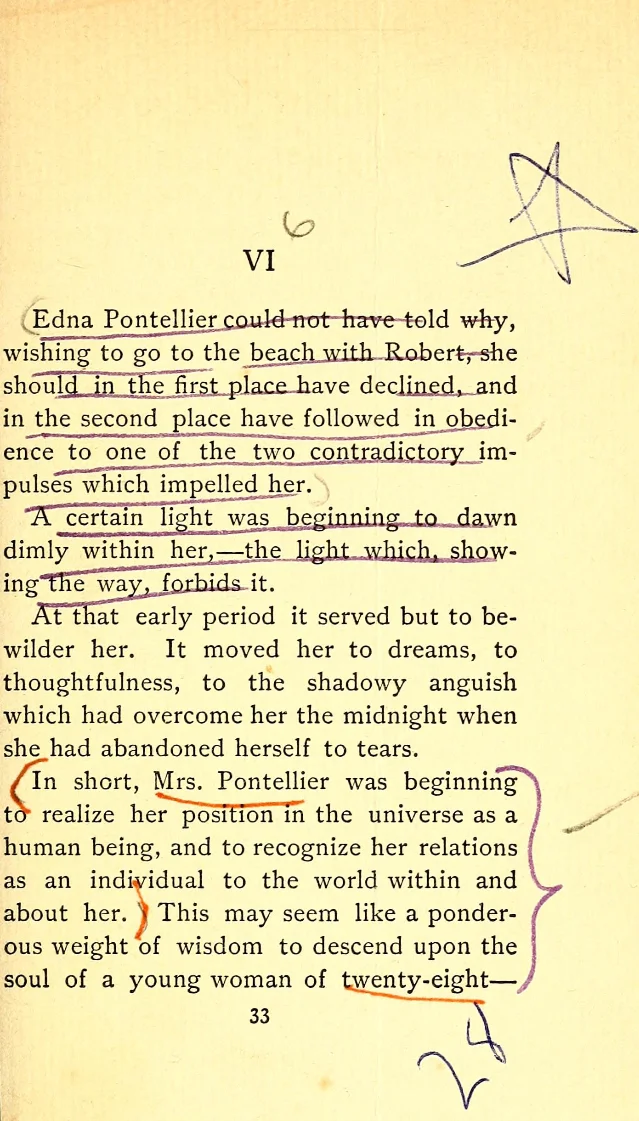
The passage
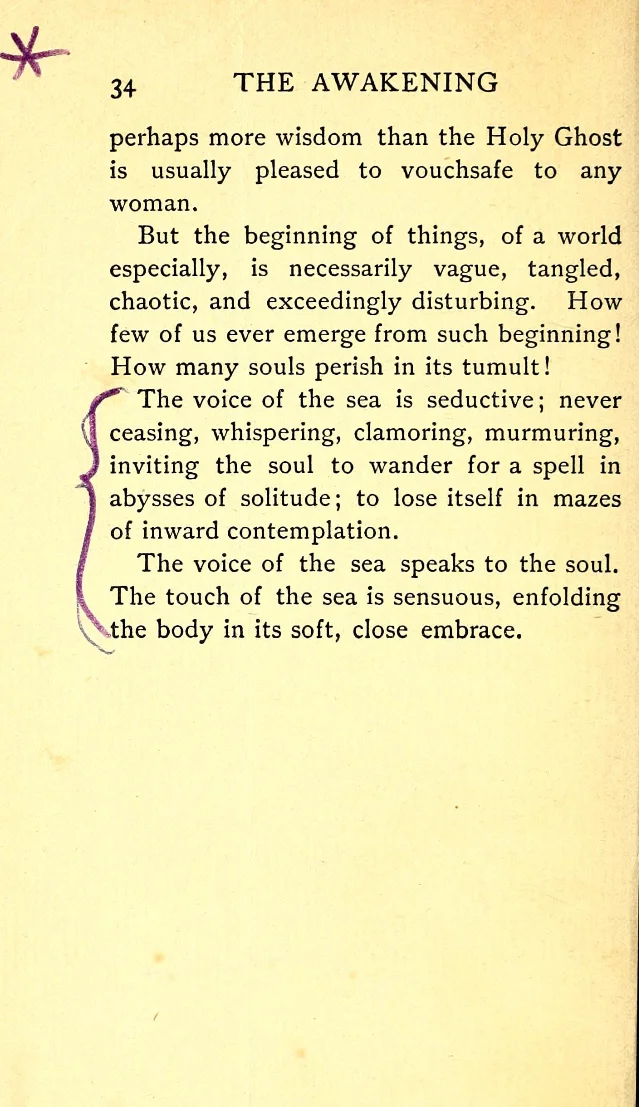
Edna Pontellier could not have told why, wishing to go to the beach with Robert, she should in the first place have declined, and in the second place have followed in obedience to one of the two contradictory impulses which impelled her.A certain light was beginning to dawn dimly within her,—the light which, showing the way, forbids it.At that early period it served but to bewilder her. It moved her to dreams, to thoughtfulness, to the shadowy anguish which had overcome her the midnight when she had abandoned herself to tears.In short, Mrs. Pontellier was beginning to realize her position in the universe as a human being, and to recognize her relations as an individual to the world within and about her. This may seem like a ponderous weight of wisdom to descend upon the soul of a young woman of twenty-eight—perhaps more wisdom than the Holy Ghost is usually pleased to vouchsafe to any woman.But the beginning of things, of a world especially, is necessarily vague, tangled, chaotic, and exceedingly disturbing. How few of us ever emerge from such beginning! How many souls perish in its tumult!The voice of the sea is seductive; never ceasing, whispering, clamoring, murmuring, inviting the soul to wander for a spell in abysses of solitude; to lose itself in mazes of inward contemplation.The voice of the sea speaks to the soul. The touch of the sea is sensuous, enfolding the body in its soft, close embrace.
— Kate Chopin, The Awakening (1899), Chapter VI. 3
A small gloss
- "Vouchsafe" means to grant or bestow, usually from a superior position. Chopin uses it with comic bite: the sentence sounds mock-theological while describing a woman's ordinary consciousness.
- "Abysses of solitude" names loneliness as a depth rather than an empty room. The phrase lets isolation feel both dangerous and inviting.
- "Sensuous" means felt through the senses. It is not merely decorative here; the sea touches the body before Edna can explain what is happening to her.
How the device works
The main device is personification, but Chopin builds it by steps rather than by a single flourish. First, awakening is a "light" that both "shows" and "forbids"; the metaphor gives consciousness a divided job. It illuminates Edna's life and immediately makes that life harder to inhabit. Then the abstract movement becomes cosmological: "the beginning of things, of a world especially." The private mood is suddenly as large as creation, but Chopin keeps it unstable, "vague, tangled, chaotic."
Only after that does the sea receive a voice. Notice the verbs: "whispering, clamoring, murmuring, inviting." They do not settle into one tone. The sea is intimate, loud, low, persuasive. That shifting sequence matters because Edna's desire is not yet a clean decision. It is pressure before it is choice. The final sentence tightens the mechanism: voice becomes touch, soul becomes body, and contemplation becomes embrace. Chopin's prose turns self-knowledge into something physical, almost tidal. Edna is not simply thinking differently; she is being addressed, surrounded, and altered.
Why it still matters
This passage catches the unsettling part of change: the mind often knows before it knows what it knows. Chopin does not make awakening tidy. It begins as bewilderment, moves through loneliness, and arrives as sensation. That is why the sea is such an exact figure. It offers no argument. It keeps speaking.
Reflection question: When have you recognized a change in yourself first as a mood, a bodily feeling, or a pull toward something, before you could name it as a decision?


Add more perspectives or context around this Post.