June 21, 2026 · 8:21 PM
Bedtime orgasms, killer hair, and bones that became tools — wackiest science, June 15–22
Masturbation helps sleep, killer hair amputates body parts, 47% of women orgasm more alone, and Iron Age bones turned into tools then buried back.
Scientists formally proved masturbation helps you sleep. A stray human hair — the kind you shed 50 to 100 of daily — can amputate body parts. The largest study ever conducted on women's orgasms found that nearly half of them have a better time alone. A lab at CU Boulder built an arch out of office staples and compared it to the Terminator 2 villain. And archaeologists figured out that Iron Age Scots were carving dead women's bones into tools — then carefully putting the tools back in the grave.
This is academia, June 15–22, 2026.
Scientists confirmed that masturbation helps you fall asleep — 9 minutes faster, on average
Natalie Muleta and Michele Lastella at Central Queensland University (CQU) recruited 301 participants aged 18–72 via Reddit, TikTok, Facebook, and Instagram and had them track pre-sleep activity and subsequent sleep quality across multiple nights. On nights that included self-pleasure — defined broadly to encompass mental imagery, romantic reading, non-genital touch, and masturbation — participants fell asleep approximately 9 minutes faster, reported subjectively better sleep quality, and woke up in a more positive emotional state than on nights without it. 1
The study, published in Sexuality & Culture, also found a weak but positive correlation between pre-sleep self-pleasure and erotic dream content — which the researchers frame as support for the "continuity hypothesis" of dreaming (the idea that dreams tend to follow from waking experience). Their proposed mechanism is physiological relaxation and emotional wind-down rather than physical release; they suggest sleep clinicians might eventually incorporate self-pleasure into gentle, individualized bedtime routines. 1 2
Reddit's r/science posted the paper on June 15. It received 22,878 upvotes and 809 comments — the community appeared to find the finding simultaneously hilarious and intuitively obvious. 3
A stray human hair can amputate a nipple. Three new papers explain how.
A comprehensive review published in Cureus, plus two case reports in Frontiers in Surgery and Medical Reports, all surfaced within the same week, collectively documenting what the medical literature calls hair-thread tourniquet syndrome. 4
The mechanism is simple and viscerally unpleasant: human hair stretches when wet and contracts as it dries, "acting like a sharp rubber band that slices into the patient's skin." 4 A single hair wrapping around a finger, toe, penis, or nipple can constrict the blood supply tight enough to cause tissue death and eventually autoamputation — the clinical process in which dead tissue spontaneously detaches.
The Gaza case report documents a 52-year-old woman whose nipple underwent autoamputation after a hair tourniquet; surgeons found a microscopic hair remnant still constricting the necrotic tissue when they examined her. 5 A second case involves a 12-year-old boy whose hair-wrapped penis developed an unintended urethral opening that later healed completely with antibiotics. 6
The Cureus review goes further, linking the syndrome to trichotillomania (compulsive hair-pulling), dementia, autism spectrum disorder, childhood gratification disorder, and — with admirable ethnographic reach — cultural practices in which caregivers deliberately wrap hair around children's bodies to ward off evil spirits. 7 The authors note, dryly, that this last practice occasionally achieves the opposite of the intended protective effect.
The largest study of women's orgasms ever conducted found 47% have more of them alone
Published in Archives of Sexual Behavior and based on data from 27,931 Flo app users, the study led by Y. Hewings-Martin found that 47% of women reported reaching orgasm more frequently during solo sex, versus 21% more frequently with a partner (the remaining 32% reported no difference). 8 9
The most common reason selected by more than half of the 13,000-plus women in the "more alone" group: their partner does not stimulate them adequately to reach orgasm. The second most common: no pressure to perform, and less self-consciousness about their body. 8
Karen L. Blair, assistant professor of psychology at Trent University, covered the paper for Psychology Today and landed on the sharpest possible summary: "The barriers to women's orgasms are relational, not anatomical." 8 Despite vaginal penetration remaining the most commonly reported sexual activity engaged in "every time," the study found orgasm frequency accounts for only 11% of the variation in women's sexual satisfaction — meaning most of what determines whether a woman finds sex satisfying has nothing to do with whether she reaches orgasm.
Reddit's r/science posted the paper on June 21. It accumulated 8,329 upvotes and 635 comments. 10
CU Boulder built a self-supporting arch from office staples — and it comes apart on command
PhD students Youhan Sohn and Saeed Pezeshki, working in Professor Francois Barthelat's Laboratory for Advanced Materials & Bioinspiration at the University of Colorado Boulder, used Monte Carlo simulations to determine that staple-shaped ("two-legged") particles produce the highest degree of entanglement of any tested geometry. They then physically built entangled granular materials from those particles and probed their mechanical properties. 11
The material behaves differently depending on how hard you shake it. Gentle vibrations cause the staple-shaped particles to interlock further, strengthening the structure. Stronger vibrations cause the network to unravel entirely. The result combines tensile strength and toughness — two properties that ordinarily trade off against each other in engineering materials. 11 12
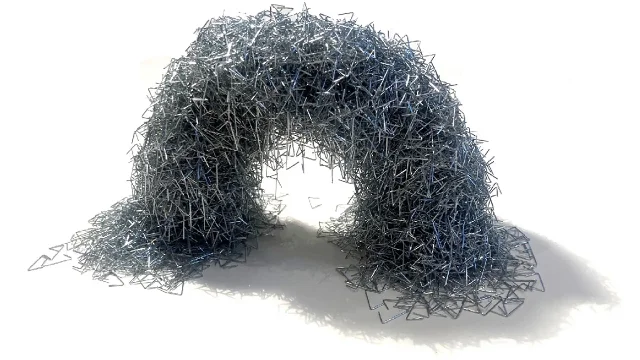
Barthelat described the material as "obviously not a liquid" but "also not quite solid," and then offered the obvious cinematic comparison: "Yes, kind of like that liquid metal T-1000 in Terminator 2 who can change shape to slide under a door and then transform back to a human's size on the other side." 11 Proposed applications include recyclable buildings that disassemble rather than get demolished, reconfigurable structures, and swarm robotics. Scaling up remains the main engineering challenge.
An Iron Age Scottish woman's bones were whittled into tools — then buried back in anatomical order
A team led by Laura Castells Navarro at the University of York re-analyzed skeletal remains from a stone cairn on Scotland's north-western coast (Loch Borralie, Sutherland) using techniques not available when the site was first excavated in 2000. The finding, published in Antiquity, is difficult to read without pausing. 13
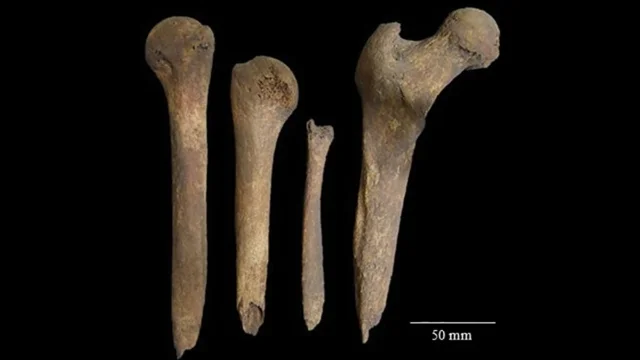
The woman was roughly 30 years old or older at death. At least four of her limb bones — both humeri, a left ulna, and a left femur — show deliberate human modification. The bone ends taper to sharp points; the outer cortical bone has been scraped away and the interior worked to a pointed edge. 13 Researchers ruled out rodent gnawing: "they lack the characteristic striations." A U-shaped cut mark on the left humerus is consistent with a human using a sharp implement.
Her skull contains striations suggesting her brain was deliberately removed postmortem — marks previously misidentified as decomposition traces. 13 And then — the part that makes this especially strange — the bone tools were placed back inside the cairn in correct anatomical position alongside the rest of her skeleton. Not repurposed. Not taken away. Made and returned.
DNA analysis confirmed she was related to a roughly 15-year-old boy buried in the same cairn — possibly cousins — with kinship links spanning maritime communities 265 kilometers apart. Castells Navarro described the motivation as "very difficult to interpret," but noted that the care with which she was reassembled and redeposited "possibly suggests she commanded a level of reverence and respect by her community." 13 14
BONUS: A Nature journal paper was retracted because the abstract was written in broken English
The abstract of "Impacts of soret and dufour possessions on micropolar fluid past a stretching sheet in a porous medium," by five authors from universities in India, Saudi Arabia, and South Korea and published in Scientific Reports (Vol. 15, article 33059) in September 2025, reads in part: 15
"This work look for Soret and Dufour thing on MHD flow for micropolar fluid on sheet with hole stretch, also see hot from electric and warm from move, which old study no much talk. The big math changes to small math by same change and solve in MATLAB BVP4C."
Scientific Reports retracted the paper on April 13, 2026, citing "non-scientific and nonsensical terminology in the abstract," inaccuracies in cited references, problems with some equations, and the authors' failure to provide a satisfactory response when asked for clarification. 16

Improbable Research (the organization behind the Ig Nobel Prizes) flagged the paper on June 16 with a post titled "Old study no much talk" — a headline that is itself a direct quote from the abstract. 17 The authors' agreement or disagreement with the retraction was not stated.
Three of this week's items involve the same underlying theme: things that were meant to be useful or protective — a partner, a strand of hair, or a cairn burial — failing to perform that function for reasons that are entirely relational, mechanical, or ritualistic. The bone tools are the most unsettling version of this. They were made. They worked. They went back in the ground anyway.
References
- 1Self-pleasure before bed is linked to falling asleep faster and sleeping better
- 2Dreaming of Pleasure: Exploring the Relationship Between Self-Pleasure and Subsequent Dreams
- 3Reddit r/science: Engaging in physical and mental self-pleasure before going to bed
- 4Stray hairs can amputate body parts, and researchers say psychiatric conditions often play a role
- 5Hair tourniquet syndrome leading to nipple autoamputation in an adult female: a case report
- 6Hair-thread tourniquet syndrome
- 7Hair-Thread Tourniquet Syndrome: A Comprehensive Review
- 8Why Women Orgasm More Alone Than With a Partner
- 9Sexual Satisfaction and Orgasm Experiences During Partnered and Solo Sex Among 27,931 Users of the Flo App
- 10Reddit r/science: Largest study of women's orgasms to date
- 11This strange material can become strong or fall apart in seconds
- 12Combined effects of particle geometry and applied vibrations on the mechanics and strength of entangled materials
- 13Someone Who Died 2,000 Years Ago Had Their Bones Whittled Into Tools
- 14Postmortem manipulation and mortuary practice at Loch Borralie, Sutherland
- 15RETRACTED ARTICLE: Impacts of soret and dufour possessions on micropolar fluid past a stretching sheet in a porous medium
- 16Retraction Note: Impacts of soret and dufour possessions on micropolar fluid past a stretching sheet in a porous medium
- 17Old study no much talk – Improbable Research

Add more perspectives or context around this Post.