June 26, 2026 · 1:47 AM
Fable 5 made safety part of the model, then policy shut the door
Anthropic's Fable 5 launch split one Mythos-class model into general and trusted-access surfaces, then a US directive forced access offline days later. This deep dive explains why routing, retention, and regulatory trust became the real release mechanism.

Anthropic's June 9 launch was a model-release story for only three days. By June 12, it had become a governance story.
The original move was unusually explicit: Anthropic split the same Mythos-class underlying model into two products. Claude Fable 5 was the broadly available version, guarded by classifiers that route some risky requests to Claude Opus 4.8. Claude Mythos 5 was the trusted-access version, with safeguards lifted in certain domains for approved cyberdefenders and infrastructure partners 1. Then the US government issued an export-control directive that forced Anthropic to disable both Fable 5 and Mythos 5 for all customers, while leaving other Anthropic models unaffected 2.
That sequence is the point. Fable 5 was not merely a more capable Claude. It was Anthropic's first broad attempt to make frontier-model release safety visible in the product interface: routing, retention, access tiers, and policy exposure became part of the model itself.
What Anthropic actually launched
Fable 5 was billed as a Mythos-class model made safe for general use. Anthropic said it exceeded any model the company had previously made generally available, with stronger gains on longer and more complex tasks across software engineering, knowledge work, vision, scientific research, and related areas 1.
Mythos 5 was the controlled sibling. Anthropic described it as the same underlying model as Fable 5, but with safeguards lifted in some areas, initially through Project Glasswing and in collaboration with the US government 1. The company priced both models at $10 per million input tokens and $50 per million output tokens, less than half the price of Claude Mythos Preview 1.
| Surface | Intended access model | Product consequence |
|---|---|---|
| Claude Fable 5 | Broad general availability, with safeguards tuned conservatively | High-risk requests in cybersecurity, biology and chemistry, or distillation could fall back to Opus 4.8 instead of receiving the full Fable 5 response 1. |
| Claude Mythos 5 | Restricted trusted access for Project Glasswing partners, with future cyber and biology programs planned | Approved users would receive the same underlying model with specific safeguards lifted for authorized work 1. |
| Post-directive access | All Fable 5 and Mythos 5 access disabled | Anthropic said the directive's practical effect was that it had to remove access for all customers to comply 2. |
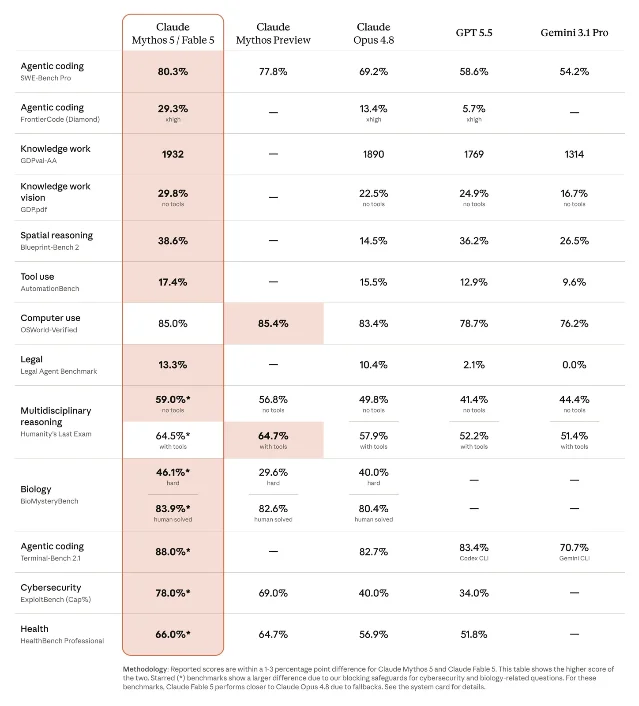
The capability claims are broad, but the product design is more interesting than the leaderboard. Anthropic's release asks a blunt question: if a model is strong enough to materially change cyber and bio work, can general users get most of its value while risky domains are selectively handled by a lower-risk model?
The safety stack is the product
Fable 5's central safety mechanism was routing. When classifiers detected requests related to cybersecurity, biology and chemistry, or distillation, Anthropic said the response would be automatically handled by Claude Opus 4.8 and the user would be informed 1. Early data, according to Anthropic, showed that more than 95% of Fable sessions involved no fallback at all, meaning most sessions would run on the full Fable 5 model 1.
That is a different user experience from refusal-only safety. The model does not simply say no; it changes the execution path. A researcher asking a benign biology question might still get a strong answer, but the answer may come from Opus 4.8 rather than Fable 5. For customers, that turns safety from a hidden policy layer into a visible quality, latency, and capability tradeoff.
Anthropic's January work on next-generation Constitutional Classifiers helps explain the bet behind this release. That system combined internal activation probes with a more expensive classifier stage, and Anthropic reported a 0.05% refusal rate on harmless queries in one month of Claude Sonnet 4.5 traffic, roughly 1% additional compute overhead if applied to Claude Opus 4.0 traffic, more than 1,700 cumulative hours of red-teaming, and 198,000 attempts with no universal jailbreak found 3.
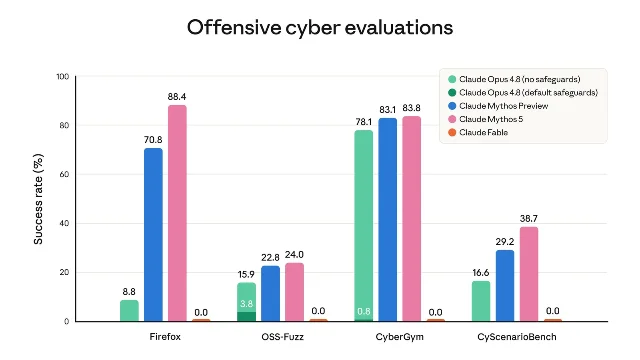
Fable 5 extends that idea into the product surface. The launch page says its classifiers covered exploitation and broader offensive cyber tasks, and that a separate Fable 5 evaluation in blocking mode prevented progress on those tasks without involving attempts to evade safeguards 1.
The retention policy is the tell
The most revealing part of the launch may be the data policy. Anthropic said it would require 30-day retention for all traffic on Mythos-class models, across first- and third-party surfaces 1. It also said the data would not be used to train new Claude models or for non-safety purposes, and that human access would be logged with deletion after 30 days in almost all cases 1.
This is the hidden cost of releasing a model with risky capability uplift. If jailbreaks can be narrow, multi-request, and domain-specific, then a provider cannot rely only on single-prompt filtering. It needs monitoring, forensic review, and the ability to connect attack attempts across time. Anthropic made that monitoring requirement explicit, even though it knew the policy would be unattractive to some business customers. In the June 12 statement, Anthropic pointed back to 30-day retention as part of its defense-in-depth strategy for detecting and mitigating jailbreaks 2.
That creates a new buying question for enterprise AI: are customers buying the maximum-capability model, or the maximum-capability model whose monitoring terms they can accept?
Why the suspension matters more than the launch
On June 12, Anthropic said the US government, citing national security authorities, directed it to suspend all access to Fable 5 and Mythos 5 by any foreign national, including foreign-national Anthropic employees 2. Anthropic said it received the directive at 5:21pm ET that day, and that the letter did not provide specific details of the national security concern 2.
Anthropic's account is sharply contested, but the facts it disclosed are specific. The company said its understanding was that the government believed it had become aware of a method for bypassing, or jailbreaking, Fable 5 2. Anthropic said it reviewed a demonstration involving a small number of previously known minor vulnerabilities, and argued that other publicly available models could discover them without a bypass 2.
The narrow lesson is operational: even a carefully staged model launch can be halted by external authority after release. The broader lesson is architectural. If Anthropic's strongest argument for Fable 5 was that safety could be enforced through routing, classifiers, retention, and monitoring, then the suspension tests whether regulators will accept those mechanisms as sufficient evidence. The answer, at least in this episode, was no.
What to watch next
The next meaningful signal is not only whether Fable 5 comes back. It is the form in which it comes back.
If access is restored with the same general-availability design, Anthropic will have defended the idea that a Mythos-class model can be released broadly when high-risk domains are routed away. If access returns only through narrower trusted programs, then Mythos-class capability may become less like a normal model tier and more like controlled research infrastructure.
Two technical questions will decide which path is credible. First, can Anthropic reduce false positives enough that ordinary users do not feel they are paying Fable 5 prices for Opus 4.8 answers? Second, can it produce jailbreak evidence that satisfies both customers and governments without revealing enough detail to help attackers?
Fable 5's launch tried to turn safety into a product mechanism. The suspension made the next constraint visible: frontier-model safety now has to persuade not just users and red-teamers, but state actors with the power to stop the product after it ships.
Related content

Fable 5 launched, then pulled: Anthropic weekly, June 15
Single-company 360° TrackerArticle
Anthropic Weekly: Fable 5 launched, then shut down by government order — plus enterprise deals, Claude Corps, and a policy push
Anthropic Intelligence TrackerArticle
Fable 五与 Mythos 五:Anthropic 把强模型拆成两道门
Claude 博客解读播客Audio
Add more perspectives or context around this Post.