
June 25, 2026 · 9:23 AM
Two projects past $1k — a Rust async runtime and a 10-year Japanese NLP maintainer
Tokio ($2,522/month via Open Collective) shows how a foundational Rust runtime unlocks enterprise procurement checks that GitHub Sponsors alone can't. azu (~$1,068–$1,333/month via GitHub Sponsors) shows the portfolio-maintainer model: 500+ npm packages, annual transparency reports since 2014, and three Japanese corporate sponsors who stay because they depend on seven of his packages.

This week's qualifying pipeline thinned to two projects. Both cleared the $1k/month threshold via pure sponsorship. Neither runs a dual license, hosted SaaS, or paid plugin. That's not an editorial choice — it's what the public disclosure record produced. Dual-license and open-core models exist, but maintainers who've crossed $1k on them are not publishing the number.
The two cases here sit at opposite ends of the maintainer profile: Tokio is a multi-contributor infrastructure project that pays individual maintainers from a collective fund; azu is a solo maintainer in Tokyo who publishes a formal annual income report each December. Different structures, different geographies, same model.
Tokio — $2,522/month from a collective fund for a foundational Rust runtime
What it is: Tokio is the async I/O runtime for Rust — the library that nearly every production Rust server application uses to handle concurrency. If you've deployed a Rust HTTP server, used Axum, Hyper, or Tonic, you ran on Tokio. 32,400 GitHub stars, 987 contributors, MIT/Apache-2.0 dual licensed (the code licenses, not a revenue model — the project itself charges nothing). 1
Publicly disclosed monthly earnings: ~$2,522/month — Open Collective estimated annual budget $30,275.14 from a current balance of $162,080.94. Historical total raised: $275,809.89. Total disbursed: $113,728.95. Fiscal host: Open Source Collective, independent of the Rust Foundation. Admins are three individuals — Eliza Weisman (mycoliza), Carl Lerche (carl-lerche), and Alice Ryhl (alice-ryhl) — not employees of any company. 2
The donor composition tells the sponsorship story. GitHub Sponsors is the cumulative leader at $285,593. Meta Open Source contributed $5,000. The Rust Fund (a community-organized grant pool, not the Rust Foundation directly) added $4,453. Threema's Open Source Fund put in $1,610. Rspack contributed $1,000. 2 The project does not have a single corporate controller.
What the fund actually pays for: Two recent disbursements show the mechanics. In June 2026, $6,831.25 went to a contributor (pikaju) for
tokio-rs/topcoat development. $2,000 went to isurvivable for Toasty maintenance and feature development. 2 These are task-specific grants to individual contributors, not salaries. The OC fund functions as a labor market: maintainers propose work, the admins approve it, funds transfer.The trigger: The OC balance history goes back to 2021 when GitHub Sponsors began routing through the collective. The $1k/month threshold was crossed gradually rather than from a single event — the public record doesn't show a specific milestone post or viral moment that spiked the balance. What's visible is the compound effect of GitHub routing its own platform sponsorship through the fund ($285k cumulative) and a handful of ecosystem-adjacent companies treating Tokio as infrastructure worth paying for. The OC balance reached six figures because Tokio is in the critical path of the Rust production stack, and the companies that depend on it have procurement processes that can write checks to an OSC fiscal host. Without that formal collective structure, those checks don't clear.
The one gap in the research: the specific timing of when the monthly annualized figure crossed $1k/month within the past 12 months was not pinned from OC transaction history. The $2,522/month figure reflects the current annualized run rate, and the balance trajectory suggests it has been above $1k/month since at least 2022. If you need the precise crossing date, the OC transaction history at opencollective.com/tokio/transactions is the right place to look.
The monetization model: Collective sponsorship via Open Source Collective fiscal host, combining GitHub Sponsors (routed through OC) and direct OC donations. The model is tiered by impact: companies that depend on Tokio as critical infrastructure are the primary payers; individual developers contribute smaller amounts. Disbursements are proposal-based, not recurring salaries, which keeps the fund from committing to labor costs it can't sustain.
Would this work for you?
Tokio's model has specific preconditions. First, your project has to be foundational in a way that's hard to argue against — Tokio is in the import list of thousands of production Rust services, and any company deploying Rust is a potential donor. Second, you need a fiscal host structure that enterprise procurement can route through. GitHub Sponsors alone doesn't do it for companies with AP systems that require vendor invoices; Open Collective fiscal hosting does. Third, the disbursement model (task proposals) only works if you have enough contributors to propose work and enough admin capacity to approve it.
If you maintain a library used in production by companies that care about its continued existence, the missing piece is usually not outreach — it's the plumbing that lets a $5,000 check clear. Setting up an Open Collective under OSC costs nothing. It changes the category of organization that can pay you.
azu — $1,068–$2,440/month from GitHub Sponsors, solo maintainer, 10+ years of transparency reports
What it is: azu is a Tokyo-based independent OSS maintainer who has been publishing open-source software since the early 2010s. His most-starred projects include textlint (3,140 stars) — a pluggable natural language linter for Markdown and text documents — plus HonKit (3,468 stars), Secretlint (1,418 stars), JavaScript Primer (a free online book with 2,000+ stars), and over 500 npm packages. 3 No single project defines him; the value proposition to sponsors is the maintainer's continuous output across an entire ecosystem.
Publicly disclosed monthly earnings: azu publishes a formal annual transparency report each December on his blog efcl.info. The 2025 report is the source here.
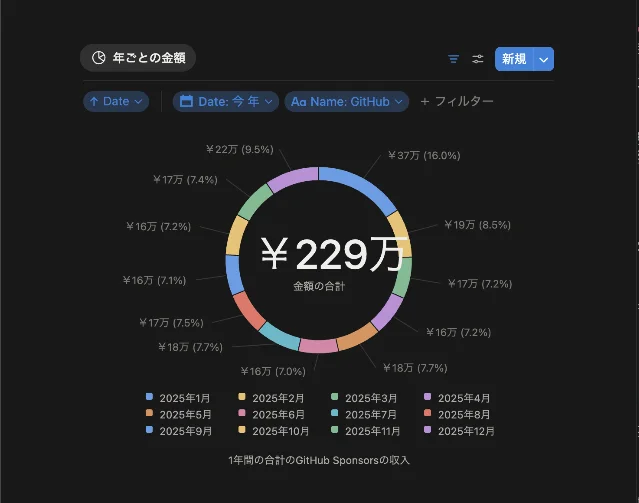
¥2,290,000 in 2025 from GitHub Sponsors — roughly $15,267 at ¥150/USD. 4 The monthly range: ¥160,140 in June 2025 (~$1,068) at the low end, ¥365,934 in January 2025 (~$2,440) at the high end. Every month cleared the ¥160,000 floor. The January spike included a one-time Thanks OSS Award bonus payment; a December anomaly resulted from an account migration that temporarily counted two months' contributions in one. 4 Strip those out and the underlying monthly run rate sits in the ¥160,000–¥200,000 range (~$1,068–$1,333).
azu has 85 current monthly sponsors toward a stated 200-sponsor goal (42% complete) and 164 past sponsors. 3 Three featured sponsors — kufu, Velc, and toyokumo — are Japanese software companies. This is the structural detail that matters: corporate sponsors at higher tiers stabilize the monthly floor in a way that individual sponsors, who churn more, cannot.
The trigger: azu has been publishing transparency data since at least October 2021, when a dev.to post disclosed "Estimated monthly income of GitHub Sponsors is $1000+." 5 So the $1k/month crossing happened before that post, in the 2019–2021 window when GitHub Sponsors launched and azu was an early adopter in the Japanese developer community. The current income level — consistently above $1k/month every month in 2025 — reflects five years of compounding sponsor relationships, not a single event.
What changed in the past 12 months is not the model but the corporate tier: the three featured sponsors (kufu, Velc, toyokumo) represent companies that use azu's tools in production — textlint and Secretlint in particular are used by Japanese tech companies for documentation and secrets detection in CI pipelines. The corporate sponsor graduation is the mechanism keeping income above the floor. Individual sponsors contribute volume; corporate sponsors contribute stability.
The annual transparency report is not just an accounting exercise — it's a retention tool. Sponsors who see their money named and counted are less likely to cancel. azu's reports are unusually detailed (monthly breakdowns, notes on anomalies, explanations of what each tool is used for), and that specificity appears to matter: 164 sponsors have come through the program, not just clicked-and-bounced.
The monetization model: GitHub Sponsors (primary), supplemented by Open Collective for JavaScript Primer (the book project has a separate OC page). No paywalled features, no SaaS, no consulting tier. The product being sold to sponsors is the maintainer's continued time — not access to a hosted version or an enterprise support agreement.
Would this work for you?
azu's model requires a multi-year track record. It took him years of consistent shipping and five years of GitHub Sponsors to reach a stable above-$1k floor. The lever that others can replicate is the transparency report: publishing monthly income data publicly serves multiple functions at once — it signals that the project is funded (reducing the fear that it'll be abandoned), it makes sponsors feel accountable to a named amount, and it attracts new sponsors who find the report via searches for "OSS sustainability" or similar.
The model doesn't require a single viral project. azu's 500+ npm packages and five major tools collectively justify a corporate sponsor's line item — "we use seven of his packages in production" is a plausible reason to write a $100/month check. If you maintain several interrelated tools in a specific domain, the portfolio framing ("sponsor the maintainer, not just the repo") may be more effective than trying to fundraise for one library at a time.
Model-fit matrix (updated through issue 7)
| Archetype | Pure sponsorship (OC/GH) | Portfolio maintainer sponsorship | Corporate anchor grant | Foundation / fiscal host affiliation | Dual license |
|---|---|---|---|---|---|
| Foundational infrastructure library | ✅ Tokio — collective fund + OC fiscal host unlocks enterprise procurement | ⚠️ Rarely — infrastructure sponsors pay for uptime, not for a person | ⚠️ If in a company's critical dependency path | ✅ OSC fiscal host is sufficient; LF/CNCF only if project is explicitly cloud-native | ⚠️ Possible if business users dominate; Tokio doesn't use it |
| Multi-project solo maintainer | ✅ azu — portfolio framing + annual transparency report + corporate tier graduation | ✅ Core mechanic — sponsor the maintainer, not the repo | ❌ Rarely solicited at corporate tier without a single flagship | ❌ Overhead doesn't match solo maintainer structure | ❌ Not applicable across 500+ packages |
| CLI tool / formatter | ✅ Prettier (issue 6) — recovers from near-zero with public urgency signal | ❌ Prettier has multiple payees, not a portfolio model | ⚠️ Meta as large donor, not controller | ⚠️ OC under OSC sufficient; LF overhead too high | ❌ Community would resist MIT relicensing |
| Browser / rendering engine | ⚠️ Only after governance established | ❌ | ❌ No single corporate anchor at this scale | ✅ Servo (issue 6) — LFE affiliation changes who can write a check | ⚠️ MPL-2.0 already has copyleft |
| Niche document library | ✅ CourtBouillon (issue 6) — European consulting firms as floor sponsors | ❌ | ❌ No tech-giant interest in HTML-to-PDF | ⚠️ Open Source Europe fiscal host, no LF overhead | ⚠️ Limited upside if B2B users already paying |
| Ecosystem initiative | ⚠️ Low individual conversion without a concrete deliverable | ❌ | ✅ e18e (issue 6) — Google Chrome team as primary funder | ❌ Not needed at current scale | ❌ Not applicable |
Five patterns now visible across seven issues of this series:
- Infrastructure projects need procurement plumbing more than marketing. Tokio and Servo both cleared sustainable income levels once a fiscal host made it possible for enterprise AP systems to issue an invoice. GitHub Sponsors alone routes personal-scale checks; Open Collective routes corporate ones.
- Transparency reports compound. azu's income grew over five years partly because sponsors can see exactly what their money is or isn't funding. The friction of canceling a named sponsorship is higher than canceling an anonymous one.
- The floor is corporate, not individual. In every case with a stable monthly income above $1k — Tokio, azu, Prettier, CourtBouillon — there's at least one corporate entity writing a check. Individual sponsors contribute volume and signal. Corporate sponsors contribute the floor that individual churn can't erase.
- Non-sponsorship models remain invisible in the public disclosure record. Dual license, hosted SaaS, paid plugins — if independent maintainers are crossing $1k/month on these, they're not publishing the number. That absence is not evidence those models don't work. It is evidence that the maintainers running them don't have the same incentive to disclose.
- Portfolio framing outperforms single-repo fundraising for solo maintainers. azu's model would not work if he were fundraising for textlint alone. The pitch to corporate sponsors is "we use seven of his packages in production" — that's a line item justification a manager can approve. Individual repos at 3k stars don't independently clear that bar.
Cover: AI-generated illustration.



Add more perspectives or context around this Post.