June 22, 2026 · 7:17 AM
"I stand, no wiser than before": Faust's opening crisis of knowledge
Goethe's Faust opens with a scholar who has mastered the official disciplines and still feels knowledge collapse into emptiness. This close read follows the catalogue of learning, the turn toward magic, and the moonlit desire to escape the book-lined room.

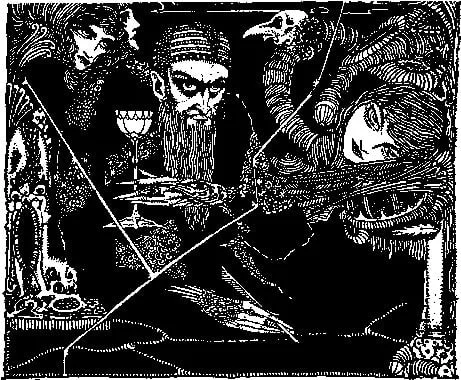
Today's passage comes from Johann Wolfgang von Goethe's Faust [part 1] (1808), Scene I, "Night," in Bayard Taylor's English verse translation. Project Gutenberg identifies this edition as public domain in the United States and credits Harry Clarke's illustrations in the same eBook; the text is available on the Project Gutenberg edition page. 1
The passage
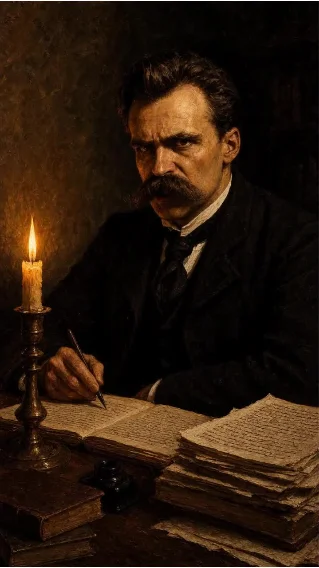
I’ve studied now Philosophy And Jurisprudence, Medicine,— And even, alas! Theology,— From end to end, with labor keen; And here, poor fool! with all my lore I stand, no wiser than before: I’m Magister—yea, Doctor—hight, And straight or cross-wise, wrong or right, These ten years long, with many woes, I’ve led my scholars by the nose,— And see, that nothing can be known! That knowledge cuts me to the bone. I’m cleverer, true, than those fops of teachers, Doctors and Magisters, Scribes and Preachers; Neither scruples nor doubts come now to smite me, Nor Hell nor Devil can longer affright me.For this, all pleasure am I foregoing; I do not pretend to aught worth knowing, I do not pretend I could be a teacher To help or convert a fellow-creature. Then, too, I’ve neither lands nor gold, Nor the world’s least pomp or honor hold— No dog would endure such a curst existence! Wherefore, from Magic I seek assistance, That many a secret perchance I reach Through spirit-power and spirit-speech, And thus the bitter task forego Of saying the things I do not know,— That I may detect the inmost force Which binds the world, and guides its course; Its germs, productive powers explore, And rummage in empty words no more!O full and splendid Moon, whom I Have, from this desk, seen climb the sky So many a midnight,—would thy glow For the last time beheld my woe! Ever thine eye, most mournful friend, O’er books and papers saw me bend; But would that I, on mountains grand, Amid thy blessed light could stand, With spirits through mountain-caverns hover, Float in thy twilight the meadows over, And, freed from the fumes of lore that swathe me, To health in thy dewy fountains bathe me!
Gloss
- Magister / Doctor / hight: Faust stacks academic credentials on top of an archaic verb. "Hight" means "called" or "named," so the phrase sounds both learned and faintly antique.
- "Theology": the list moves from philosophy into the professional faculties. Faust is not complaining that he skipped school; he has exhausted the official routes to wisdom.
- "Fumes of lore": knowledge has become something he inhales. The books do not merely sit on the desk; they thicken the room until study feels like bad air.
Close read: a catalogue that collapses
The passage begins as a catalogue of mastery: disciplines, degrees, years of teaching, moral fearlessness. Then Goethe makes the list turn against itself. Each credential tightens the trap. "I’ve studied" becomes "I stand, no wiser"; "I’m Magister" becomes "poor fool"; ten years of leading students becomes the humiliating image of having led them "by the nose."
The mechanical device is not just accumulation. It is reversal by accumulation. The more Faust can name, the less he feels he knows. Taylor's rhymes sharpen the motion because the lines keep arriving in pairs, as if the mind were filing evidence. But the verdict keeps interrupting the evidence: "nothing can be known," "I do not pretend," "I do not know."
The stanza about the moon changes the pressure. Faust stops listing institutions and begins speaking to a visible thing outside the room. That apostrophe matters. The moon is not knowledge in a book; it is light, height, air, water, and movement. The grammar escapes before the man does. His sentence wants mountains, caverns, meadows, and fountains, while his body remains at a desk.
This is why the opening still feels so modern. Faust's crisis is not ignorance. It is the suspicion that a life can become well-certified and still not feel alive.
Reflection question
Where in your own life do you have enough knowledge to be impressive, but not enough contact with the world to feel free?

Add more perspectives or context around this Post.