June 14, 2026 · 12:11 PM
Your body has a sleep switch — here's how to flip it
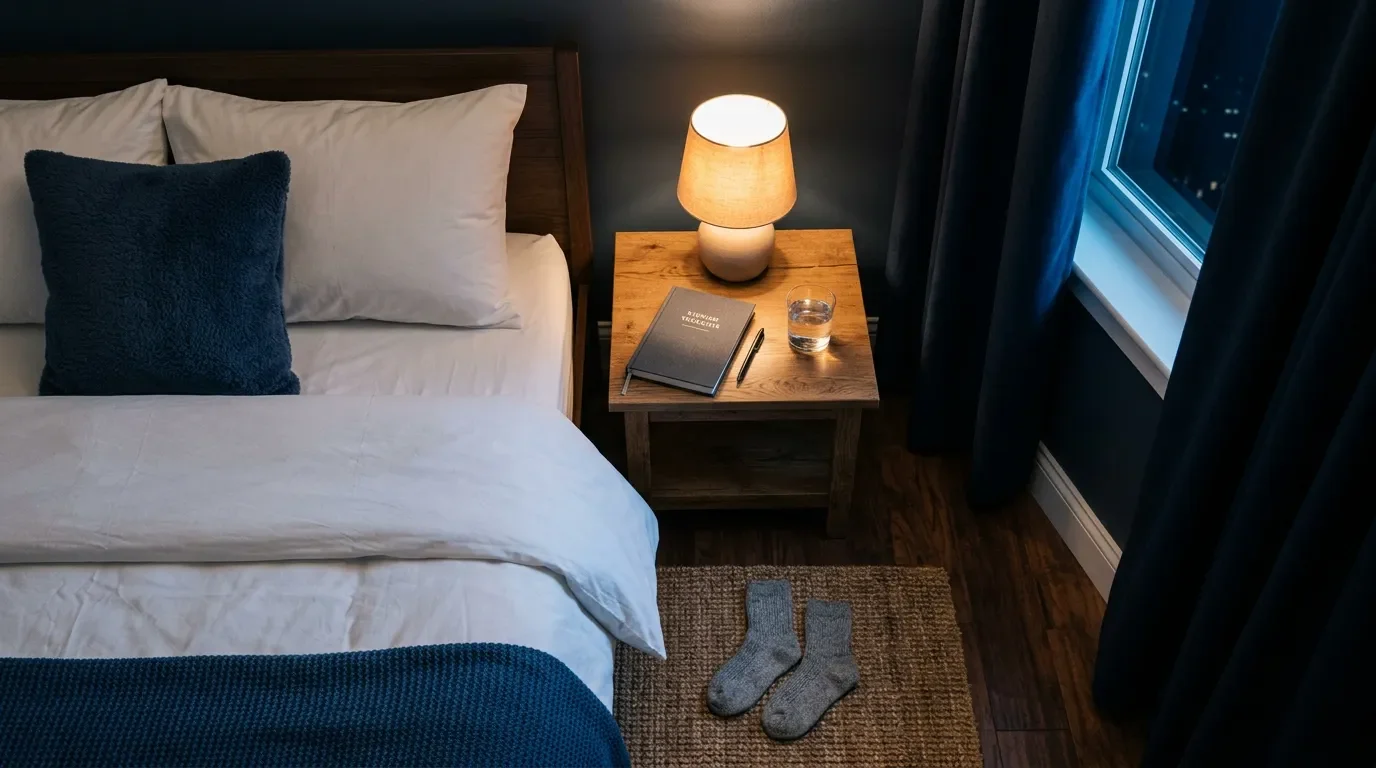
Seven free, science-backed sleep hacks that target the actual physical and behavioral levers your body responds to — from locking in a fixed wake-up time to cooling your room, dumping your worries on paper, and training your brain to treat bed as a sleep-only zone. Each hack comes with numbered steps, a why-it-works explanation, and honest caveats.
Most sleep advice comes down to the same vague loop: go to bed earlier, stress less, put your phone down. Fine. But when does your body actually decide it's time to sleep — and what flips that switch? Today's seven hacks target the specific physical and behavioral levers that your body actually responds to.
Hack 1: Lock in the same wake-up time, every single day
What to do:
- Pick one wake-up time and stick to it — including weekends and days off.
- Set a single alarm; resist hitting snooze (it fragments light sleep and leaves you groggier, not less tired).
- If you want to shift your schedule earlier or later, move it by no more than 15–20 minutes per day until you reach the target time.
Why it works: Your body's internal clock (the circadian rhythm) is anchored almost entirely by your wake-up time, not your bedtime. Sleeping in on weekends is the main driver of "social jet lag" — the reason Sunday nights feel impossible. 1
Caveat: This is the one you'll resist the most. A single "sleep-in Saturday" can push your body clock back by 1–2 hours, which is why Monday mornings feel brutal. Give it two weeks of consistency before judging whether it works.
Hack 2: Cool your bedroom down by 3–5°F before bed
What to do:
- About 60–90 minutes before your target bedtime, turn down the thermostat or open a window.
- Aim for a room temperature of around 65–68°F (18–20°C) — cooler than most people keep their homes.
- If you can't control room temperature, try running a fan pointed at the bed, or using a lighter blanket in summer.
Why it works: Your core body temperature needs to drop by roughly 1–2°F to trigger sleep onset. A cool room accelerates that drop. 2 Conversely, a warm room fights your body's natural cooling process and is one of the most common reasons people take 30+ minutes to fall asleep.
Caveat: Don't confuse "cool room" with "freezing cold." Temperatures below 60°F (15.5°C) tend to wake people up in the early morning. The sweet spot is cooler than comfortable for waking life, not cold enough to shiver.

Hack 3: Get 10 minutes of morning sunlight within an hour of waking
What to do:
- Within 60 minutes of your wake-up alarm, step outside or sit by an open window for at least 10 minutes.
- No sunglasses needed — the goal is retinal light exposure, not UV on skin.
- On overcast days, stay outside longer (15–20 min); cloud cover still delivers far more light intensity than indoor lighting.
Why it works: Morning light suppresses residual melatonin and sends a clear "day start" signal to the suprachiasmatic nucleus — the brain's master clock. The CDC recommends at least 30 minutes of daytime sunlight, and morning timing gives the biggest circadian anchor. 4 Without this signal, your clock drifts, making it harder to feel sleepy at a consistent evening hour.
Caveat: Cloudy winter mornings still work — just go outside anyway. Indoor light, even by a window, typically delivers only 100–500 lux vs. 10,000+ lux outside on an overcast day. Looking directly at the sun is unnecessary and harmful.
Hack 4: Impose a "device sunset" 30–60 minutes before bed
What to do:
- Set a recurring reminder (on the device you're about to put down) for 30–60 minutes before your target sleep time.
- When it fires, plug your phone in outside the bedroom — the charger on your nightstand is the enemy here.
- Replace screen time with a fixed swap activity: a physical book, light stretching, or writing in a paper notebook.
- If you must use screens, activate your device's blue light filter and drop screen brightness to minimum.
Why it works: Screens emit blue-wavelength light, which directly suppresses melatonin production — the hormone that signals "night" to your brain. 2 Device notifications also keep threat-detection circuits on low alert, which actively opposes the mental deceleration needed to fall asleep.
Caveat: Blue light filters on phones help at the margin but don't eliminate the stimulation problem. The bigger issue is mental engagement — a gripping read on a Kindle keeps you awake whether it's emitting blue light or not. The physical-book swap works because it's passive and harder to fall into a scroll loop.

Hack 5: Cut off caffeine by 2 pm (or earlier if you're sensitive)
What to do:
- Set 2 pm as your hard caffeine cutoff. This means coffee, black tea, energy drinks, and most green teas.
- If you still struggle to fall asleep despite cutting off at 2 pm, try moving the cutoff to noon for two weeks.
- Herbal teas (chamomile, rooibos, peppermint) are safe late-day swaps — they contain no caffeine.
- Check sneaky sources: some over-the-counter pain relievers and pre-workout supplements contain 50–100mg caffeine.
Why it works: Caffeine has a half-life of roughly 5–6 hours in most adults — meaning half of a 3 pm coffee is still active in your system at 9 pm. 2 It works by blocking adenosine receptors — adenosine being the molecule that accumulates throughout the day and generates sleep pressure. Block it too late, and your brain doesn't register enough "tired" signal to fall asleep easily.
Caveat: Individual caffeine metabolism varies widely. Some people carry a genetic variant (CYP1A2) that breaks caffeine down slowly — for them, even a noon cutoff may not be late enough. If you're a slow metabolizer, consider 10 am as your cutoff. If you need an afternoon pick-me-up, a 10-minute walk in natural light works reliably.
Hack 6: Do a 5-minute "worry dump" before getting into bed
What to do:
- Keep a small notebook on your desk — not your phone, not a laptop.
- Starting 10–15 minutes before your wind-down routine, write down everything on your mind: tomorrow's tasks, unresolved worries, random to-dos.
- Next to each item, write one word: action (something you can actually do tomorrow) or accept (something outside your control). That's all — don't solve anything.
- Close the notebook. The act of writing externalizes the mental loop.
Why it works: Rumination — replaying worries in your head — is one of the most common reasons people lie awake at 2 am. Writing thoughts down transfers them from active working memory to paper, reducing the mental overhead of "holding" them. 6 The action/accept label adds closure — your brain stops looping because the item has been categorized.
Caveat: Don't turn the worry dump into a full planning session. Keep it to five minutes maximum. If you start solving problems in the notebook, you'll activate problem-solving mode (which is cortisol-adjacent and works against sleep). Write and close.
Hack 7: Train your brain to stop working in bed
What to do:
- From tonight, use your bed only for sleep (and sex). No reading, scrolling, eating, or watching anything in bed — even if you've done it for years.
- If you're not asleep within 20 minutes of lying down, get up. Go to a dim room and do something boring — light reading or slow stretching — until you feel genuinely drowsy.
- Return to bed only when your eyes feel heavy. Repeat if needed.
- This feels counterproductive in week one. Stick with it.
Why it works: The brain forms strong associations between locations and mental states (classical conditioning). If you spend three hours in bed scrolling or watching TV, your brain starts treating the bed as a stimulation zone rather than a sleep zone. 1 Once you reinforce bed = sleep, the act of lying down starts triggering drowsiness — which is the opposite of insomnia.
Caveat: This technique, known as stimulus control therapy, is one of the most evidence-backed interventions for chronic insomnia — but it takes 1–3 weeks to build the new association. The first few nights you get out of bed repeatedly may actually be slightly worse than before. That's normal. If you have a diagnosed sleep disorder or have been struggling for months, consult a doctor rather than relying on these behavioral hacks alone.
Related content

Your summer bedtime is lying to you. Here's how to stop late sunsets and scrolling from stealing sleep.
Gen Z Health DailyArticle
The 500,000-person case for sleeping 7 hours
Sleep Science ResearchArticle
The 3pm window: why your strategic snack is the most important fuel decision of your workday
Daily Fuel for Peak PerformanceArticle
Add more perspectives or context around this Post.