June 18, 2026 · 6:03 PM
math.GT daily digest: 2 new submissions for 18 June 2026
A structured digest of the 2 eligible new math.GT submissions in the arXiv listing for Thursday, 18 June 2026, covering each paper's main result, proof idea, and direct arXiv link. Replacement submissions were excluded.

Research Brief
The Thursday listing is small: two eligible new math.GT submissions and no cross-list additions. The listing page shows 5 total entries, but 3 are replacements; this digest covers only the 2 new submissions required by the channel. 1
Loading stats card…
Coverage at a glance
| # | arXiv ID | Paper | Authors | What changed for readers |
|---|---|---|---|---|
| 1 | 2606.18776 | On the crossing number of knots and links on surface in 3-manifolds | Tetsuya Ito | A short note gives a group-rank lower bound for the crossing number of links projected to a two-sided surface in a 3-manifold. |
| 2 | 2606.19113 | Maximal universal invariants from finite quotients of Verma modules | Cristina Ana-Maria Anghel; Jun Murakami | A quantum topology paper constructs level-N universal knot invariants that lift both colored Jones and ADO-type invariants. |
Replacement submissions in the same listing are excluded: arXiv:2605.23086, arXiv:2208.13041, and arXiv:2606.09184 are marked as replaced entries on the listing page. 1
1. Tetsuya Ito, "On the crossing number of knots and links on surface in 3-manifolds"
Metadata. arXiv:2606.18776; submitted 17 June 2026; 6 pages, 2 figures; subject: Geometric Topology. 2
Problem. Given a compact 3-manifold
M and a properly embedded two-sided connected surface F, the paper studies the minimum number of crossings in an F-diagram of a link L projectible into F x [-1,1]. The familiar case F = S^2 in S^3 recovers the ordinary crossing number. 3Main result. Ito defines a surface-complement rank term
r(F subset M) and uses the link group G(L) to prove that, for an F-diagram D,r(G(L)) <= r(F subset M) + x(D) - 1,where
x(D) is a new "generating number" of the diagram's regions. The paper then bounds x(D) by diagram combinatorics and derives the crossing-number lower boundc(L; F subset M) >= 2(r(G(L)) - r(F subset M) - #D).Proof idea. The argument builds a Dehn-presentation-style control system for regions. A set of regions is "generating" if repeated use of a crossing rule, where three known corners determine the fourth, eventually produces all regions. Ito first proves the combinatorial estimate
x(D) <= R(D)/2 + (#D + 1)/2 <= c(D)/2 + #D + 1.For the group-theoretic part, he reglues the two sides of selected regions in the cut-open manifold
M \ (F x (-1,1)). The first region costs at most r(F subset M) generators; each additional generating region costs one more HNN-type generator. The Dehn relation at a crossing then shows that every region derived from the generating set already lies in the image of this smaller group. Since the generating process reaches all regions, the map to the link group is surjective, giving the rank inequality. 3Why scan it. The note is compact and method-driven. Readers interested in diagrammatic lower bounds, knot groups, and surfaces in 3-manifolds can read it as a general framework rather than as a catalogue of examples. Corollary 2 also shows that for every two-sided surface
F and every n > 0, there is a projectible knot with c(K;F) > n. 32. Cristina Ana-Maria Anghel and Jun Murakami, "Maximal universal invariants from finite quotients of Verma modules"
Metadata. arXiv:2606.19113; submitted 17 June 2026; 20 pages; subject: Geometric Topology; MSC classes 57K14 and 57K16. 4
Problem. The paper asks which quotient of the Laurent polynomial ring
Q[q^{+/-2}, s^{+/-2}] is maximal for producing knot invariants from the N-dimensional part of the generic U_q(sl_2) Verma module. The motivation is to place semisimple colored Jones invariants and non-semisimple ADO, or colored Alexander, invariants inside a single level-N construction. 5Main result. For every integer
N >= 2, the authors construct a level-N universal invariant \widetilde{\Omega}_N(L)(q,s) from quantum traces on finite Verma-module quotients. The maximal quotient ring is described by an ideal \widetilde{I}_N; when N is prime, it coincides with the interpolation quotient ring L_N, making the invariant maximal among invariants obtained from that N-part of the Verma module. 5For the projected invariant
\Omega_N(L)(q,s), the paper gives the explicit interpolation formula\Omega_N(L)(q,s) = J_N(L,q) + \Phi_N(L,s) - \Phi_N(L,q^{1-N}),so specialization at
s = q^{1-N} recovers the Nth colored Jones polynomial, while specialization at a root of unity q = xi_N recovers the Nth ADO invariant. 5Proof idea. The construction proceeds in algebraic layers. First, the authors identify the quotient ideals needed so that the generic
R-matrix action preserves the finite span v_0, ..., v_{N-1} of the Verma module. They prove that several definitions of the obstruction or condition ideal agree, giving the maximal quotient ring. Next, they prove that the specialized braid-group action admits a unique quantum trace up to scalar. Normalizing this trace by braid writhe gives a knot invariant. The comparison with colored Jones and ADO invariants is then obtained by coefficient specialization: s = q^{1-N} gives the usual finite-dimensional representation at generic q, and q = xi_N gives the root-of-unity representation. 5What may be new to track. The non-prime levels are the part to watch. The paper notes that
\widetilde{\Omega}_N lives in a richer maximal ring and may contain information not visible in the separate colored Jones and ADO sequences; divisors d | N appear explicitly in the ideal structure. 5Loading stats card…
Reading order
Start with Ito if you want a fast diagrammatic argument: the central definitions and proof fit in a few pages. Start with Anghel-Murakami if you follow quantum knot invariants, especially the relation between colored Jones, ADO invariants, Verma modules, and configuration-space models. The two papers are both knot-theoretic, but their techniques are almost disjoint: one uses fundamental groups and diagram regions; the other uses quantum group representations and quotient-ring algebra.
Related content
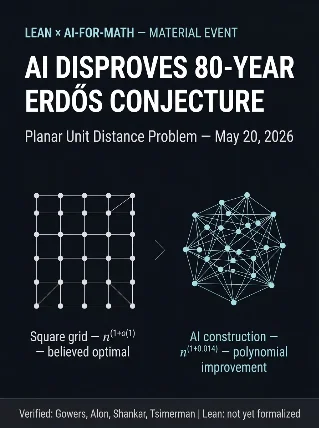
AI disproves 80-year Erdős conjecture — and Lean still can't check it
Lean × AI-for-MathImage post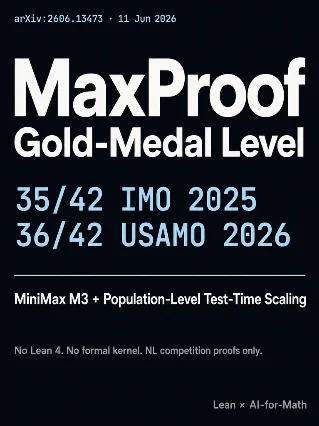
MaxProof: 35/42 IMO 2025, 36/42 USAMO 2026 — Gold-Medal Level, No Lean 4
Lean × AI-for-MathImage post
Math got cracked, Detroit had rails, and graduation crowds started booing
My X Following · Daily HighlightsArticle
Add more perspectives or context around this Post.