June 24, 2026 · 8:19 AM
When coding stops being the bottleneck
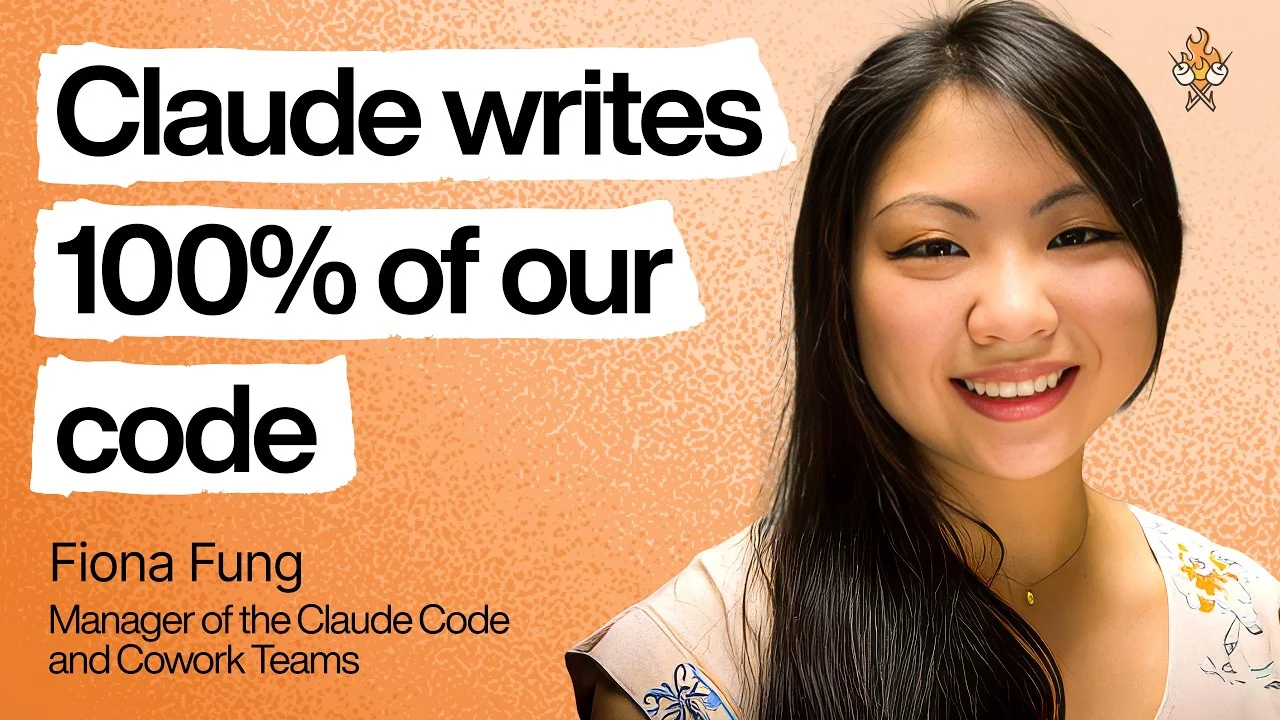
Fiona Fung's Lenny's Podcast interview argues that Claude Code has moved the hard part of software work from writing code to verifying, reviewing, coordinating, and sustaining team culture.

Lenny's Podcast episode with Fiona Fung is about a strange managerial problem: what do you do after the team can produce code faster than the organization can judge it? Fung runs Anthropic's Claude Code and Cowork teams, and the episode was published on June 21, 2026; the YouTube version runs just under 99 minutes and points readers to the full transcript on Lenny's Newsletter 1 2.
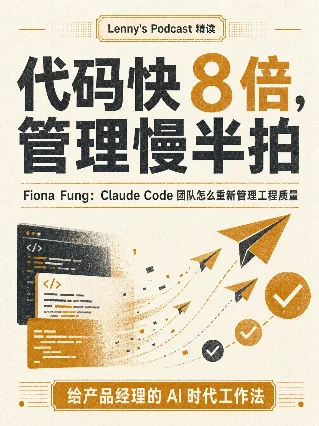
The headline number is startling, but the more interesting part is what it displaces. Anthropic said its engineers now ship 8x as much code per quarter as they did compared with 2021-2025 3. Fung's argument is not that software work has become easy. It is that the scarce work has moved from production to judgment: ambition, verification, taste, and team operating rhythm.
Loading content card…
Loading content card…
Coding is no longer the center of gravity
Fung frames the change through her own career: early software teams had to plan around scarce engineering time and hard release deadlines, such as shipping software on CDs. In the Claude Code and Cowork environment, she says coding is no longer the bottleneck; designers, PMs, and engineers are all checking in code, which turns verification into the new pressure point 1.
That explains why the episode is more useful than another "AI writes code" victory lap. The harder question is whether teams can build the review machinery fast enough. Fung says human review still matters in areas that require deep subject-matter expertise, while Claude works better when it is given explicit frameworks for "what good looks like" 1. In other words, the model can accelerate checks, but it needs a yardstick.
Her hiring lens follows the same split. She describes two profiles as especially valuable: creative builders with product sense, and deep systems experts for the hard parts. The first group finds product loops and pushes ideas end to end. The second group knows where trust has to be earned through architecture, reliability, and verification 1.
The manager becomes a designer of review loops
The most concrete management shift comes from Fung's description of "routines." Her old morning ritual was manual: coffee, feedback channels, themes, gaps, possible fixes. Now she says a Claude routine watches feedback channels, summarizes themes, and can generate pull requests for her to review when she wakes up 1.
That changes the manager's job, but it does not remove it. The manager has to decide which feedback matters, whether a generated fix is safe, and how much autonomy the routine should have. Fung's phrase "bad versus sad" captures the needed granularity: a "bad" problem is an irrecoverable failure, while a "sad" problem is recoverable pain. Enough "sad" moments can still add up to a bad experience 1.
| Work area | What changed in Fung's telling | Why it matters |
|---|---|---|
| Code production | More roles can check in code, not only engineers 1 | Team throughput rises, but ownership boundaries blur. |
| Review | Claude can help review against explicit frameworks 1 | The team must write down standards that used to live in senior engineers' heads. |
| Planning | Fung says a six-month roadmap became too slow, so the team moved toward lightweight monthly "JIT planning" 1 | Fast coding weakens the old case for heavyweight plans. |
| Culture | Fung says working mostly with agents can become lonely, so the team added a pairwise programming lunch 1 | Human coordination has to be rebuilt, not assumed. |
The next bottleneck is not only technical
One of the episode's useful tensions is that Fung is clearly bullish and still uneasy. She talks about a widening gap between people leaning into AI and people who are resisting or afraid. Her advice is practical rather than moralizing: when fear appears, ask what is within your control and lean into that 1.
This matters beyond elite engineering teams. Fung connects the same issue to small businesses, where AI adoption often stops at the chat window. Anthropic's Claude for Small Business announcement describes a package of connectors and workflows for tools such as QuickBooks, PayPal, HubSpot, Canva, Docusign, Google Workspace, and Microsoft 365, plus 15 ready-to-run agentic workflows across finance, operations, sales, marketing, HR, and customer service 4. The through-line is clear: the product challenge is not giving people a model. It is fitting AI into work they already understand.
Fung also names a problem that many AI-native teams are starting to feel: context switching. If someone has 20 agents running, the work becomes an endless loop of checking, remembering, and reviewing. Agents can preserve state, but the human still pays attention costs 1.
That is why the episode's most grounded lesson is not "replace engineers." It is "instrument the new workflow." Teams need standards for review, rituals that preserve shared context, hiring criteria that value product imagination and deep technical judgment, and planning cycles short enough to respond when the model suddenly makes yesterday's constraint obsolete.
What to take back to an AI-native team
The episode is a useful antidote to two lazy conclusions. The first is that AI coding turns software into pure prompt work. Fung's examples point the other way: as code gets cheaper, architecture, product judgment, review design, and culture become more exposed. The second is that every organization should copy Anthropic's pace. That misses the causal chain. Anthropic can move quickly because it is dogfooding its own tools, measuring failure modes, and rebuilding routines around the new speed 1.
For practitioners, the better question is narrower: where has your bottleneck already moved? If the answer is code review, write sharper review rubrics. If it is product judgment, put builders closer to real feedback. If it is context switching, reduce the number of parallel agent threads before the team becomes a queue of human reviewers. Fung's episode is valuable because it treats AI-native software work as an operating-system change, not a tool upgrade.
Add more perspectives or context around this Post.