
June 10, 2026 · 12:19 PM
The 25C energy credit is dead — but your 2025 upgrades can still save you up to $3,200
Congress killed the Energy Efficient Home Improvement Credit after December 31, 2025 — but if you installed a heat pump, new insulation, efficient windows, or a high-efficiency HVAC system any time in 2025, you can still claim up to $3,200 on your 2025 return. This issue covers exactly who qualifies, which form to file (Form 5695 Part II), the deadline, and the average amount claimed.

Dead — but your 2025 work still counts
Congress killed the Energy Efficient Home Improvement Credit (25C) on December 31, 2025. Done. But if you upgraded your home any time in 2025 — heat pump, insulation, windows, HVAC, energy audit — you can still claim it on your 2025 return.1
Average claim in 2023: $882. Heat pump cap: $2,000. You can't collect what you don't claim.2
Loading stats card…
Not tax advice. Rules changed in 2025. Verify eligibility at the IRS links below before filing.
Who qualifies
All of these must be true:
- You own the home (not a rental) and it's your primary U.S. residence
- The upgrade was installed and operational in 2025 — not just ordered or contracted
- The home is existing construction, the equipment is new
You're out if you're a landlord, if it's a vacation home, or if the property is used exclusively for business.1
What you can claim
30% of qualifying costs, capped by upgrade type:
| Upgrade | Cap |
|---|---|
| Heat pump / heat pump water heater | $2,000 combined |
| Insulation & air sealing | $1,200 (no labor) |
| Windows & skylights | $600 total |
| Central A/C, furnace, boiler | $600 per item |
| Electrical panel (200A+) | $600 |
| Exterior doors | $250/door, $500 max |
| Home energy audit | $150 |
For equipment (heat pumps, A/C, furnaces, panels), your installer needs to provide a Qualified Manufacturer ID (QMID). Insulation doesn't require one. Look up registered models at the IRS qualified manufacturers list.1
The form: 5695 Part II
File Form 5695, Part II with your 1040. Credit flows to Schedule 3, Line 5 — dollar-for-dollar off your tax bill. Nonrefundable — you can only claim up to what you owe; nothing carries forward (and there's nowhere to carry it now anyway).1
Already filed without it? Use Form 1040-X within 3 years of your original filing date.
The deadline
2025 is the last year this credit exists. No carry-forward. No second chance.
| Filing situation | Deadline |
|---|---|
| Filing on time | April 15, 2026 |
| Filed for an extension (Form 4868) | October 15, 2026 |
| Already filed — need to add the credit | 3 years from original filing date (Form 1040-X) |
How to claim it
- Receipts — invoice showing cost and install date
- QMID — from your installer or IRS manufacturer list (equipment only)
- Form 5695 — download from IRS or let TurboTax / H&R Block / FreeTaxUSA pull it up automatically (search "energy credits")
- File — attach to 1040, or file 1040-X to amend
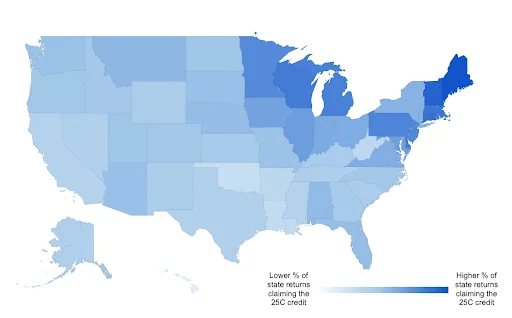
Who's actually claimed it
2.3 million households in 2023. Average: $882. More than 500,000 of them earned under $50K. This isn't a rich-homeowner perk.2
Loading chart…
What the OBBB did
The One Big Beautiful Bill (PL 119-21, signed July 4, 2025) moved the 25C sunset from 2032 to December 31, 2025. IRS confirmed in FS-2025-05: nothing placed in service after that date qualifies. 2025 installs are fully eligible.3
Same story for Section 25D (solar, battery, geothermal): terminated after December 31, 2025. 2025 = claimable. 2026 = nothing.3
Tax rules change. Verify eligibility before filing. When in doubt, consult a licensed tax professional.



Add more perspectives or context around this Post.