


The Vivendi Universal collapse
June 13, 2026 · 3:00 AM

The Vivendi Universal collapse

Jean-Marie Messier took a 150-year-old French water utility and spent $77 billion turning it into a global media empire in under six years — then lost it in two. This case study traces the €35 billion debt build-up, the deliberate concealment of a cash crisis, Claude Bébéar's five-stage boardroom coup, and Fourtou's fire-sale recovery. Four frameworks: Roll's hubris hypothesis, overleverage fragility, boardroom coup choreography, and the negotiauction.

In six years, Jean-Marie Messier turned a 150-year-old French water utility into a $77 billion global media empire. In the following two, he destroyed most of it. The Vivendi Universal implosion of 2001–2002 is the definitive case study in what happens when a single executive combines unconstrained acquisition appetite, elite-network governance that rewarded boldness and punished dissent, and a deliberate strategy of hiding the debt hole that resulted. By the time the boardroom coup landed on July 2, 2002, the company carried €35 billion in debt, its Paris shares had fallen to a 15-year low, and the incoming CEO later disclosed that without a management change the firm would have been insolvent within days. 1
For deal-makers and directors, the case illuminates four compounding failure modes — hubris-driven M&A, overleverage fragility, principal-agent breakdown, and a boardroom coup that followed its own precise choreography — each of which is reusable in other contexts.

The parties and their stakes

PartyStated objectiveLeverageBATNAHidden preference
Jean-Marie Messier (Chairman-CEO)Build Europe's first global media competitor to Time Warner and News CorpTotal PDG authority; French elite network; personal charismaFight from the chair; claim financial stabilizationSurvive with the top job intact; exit with a rich package if forced
Edgar Bronfman Jr. (Largest shareholder; Vice-Chairman)Protect Bronfman family investment after trading Seagram for Vivendi stock14-person board held 3 Bronfman-aligned seats; family's stock had lost >$1 billion of valueForce an emergency board meeting; threaten legal actionRemove Messier; recover some shareholder value before the firm hit insolvency
Claude Bébéar (AXA founder; Vivendi board member)Protect French capital-market credibility; prevent Vivendi's collapse from infecting French banksCalled the public "clarion call" — a signal that broke the board's silence 2Use his establishment network to flip French directorsPreserve AXA and BNP Paribas's exposure; install a French insider as successor
Jean-René Fourtou (Aventis Vice-Chairman; eventual successor)Stabilize the company and begin asset salesCredibility with French banks; no association with Messier's failuresTurn down the role — no obligation to acceptPrevent bankruptcy; Fourtou later disclosed Vivendi was within 10 days of insolvency when he took over 3
French banking syndicate (led by BNP Paribas)Recover loans; avoid sovereign contagionSole source of emergency credit — could accelerate defaultWithdraw credit lines and force insolvencyCondition new lending on Messier's removal, then return support once done 4
Moody's / S&PReflect credit realityRating actions triggered debt covenants; junk designation on July 2 was the public executionMaintain investment grade and face credibility damageDowngrade to junk to force restructuring

From water mains to Universal Studios: the acquisition spree (1996–2001)

Messier, 39 years old, took over Compagnie Générale des Eaux — founded in 1853, best known for municipal water contracts — in 1996. 5 His predecessor Guy Dejouany had built a sprawling French conglomerate. Messier's mandate was modernization. He exceeded it dramatically.
Between 1997 and 1998, he acquired a 30% stake in Havas (Europe's largest advertising group) and then merged Vivendi with it outright, entering publishing. The company was renamed Vivendi in 1998 — from the Latin vivendum, meaning "living." He built Cegetel into France's second-largest telecom operator in partnership with Vodafone, and absorbed Canal+, Europe's largest pay-TV company. 5
The company's debt at this stage was roughly €3 billion — manageable for its revenue base. That would not hold.
On June 20, 2000, Messier announced the transformational deal: a $34 billion all-share acquisition of Canada's Seagram Company, owner of Universal Studios and Universal Music Group — the world's largest recorded-music business, with a 22% global market share. 6 The Bronfman family, which had built Seagram into a spirits-and-entertainment hybrid, received Vivendi shares. Edgar Bronfman Jr. became Vice-Chairman. At the announcement, Messier told reporters: "For the first time in Europe, there is a communication group of a size that will be able to rival all the American giants." 6
CBS Radio reported that the combined company would have annual revenues above $55 billion "without debt." That claim was immediately questionable — Seagram carried roughly $6.6 billion in obligations — and was quietly dropped from subsequent presentations. The deal closed in December 2000.
What followed was a 12-month purchasing escalation that analysts and even some of Messier's internal circle struggled to justify:
  • June 2001: Houghton Mifflin acquired for $1.7 billion cash plus $500 million in assumed debt ($2.2 billion total), making Vivendi the world's second-largest educational publisher behind Pearson. An unnamed analyst, quoted by the Los Angeles Times, was blunt: "Educational publishing is a decent, slow-growth business. But there are no synergies with Universal Pictures, Universal Music or Canal Plus." 7
  • May 2001: MP3.com purchased for $372 million.
  • December 2001: Barry Diller's entertainment assets from USA Networks acquired for approximately $10.3 billion, creating Vivendi Universal Entertainment. Diller received a 1.5% stake worth a guaranteed $275 million. 8
  • 2001: 10% of EchoStar (satellite TV, 18 million+ potential subscribers) purchased for $1.5 billion.
  • 2001: Vizzavi, a joint internet portal venture with Vodafone, absorbed $1.34 billion before being effectively shut down.
By June 30, 2002, Vivendi Universal's total debt stood at €35 billion, per its own SEC filing. 9 Of that, €19 billion sat in the media and communications division. Bear Stearns analyst Nicholas Bell calculated that short-term obligations due within 12 months were €7.5 billion, against only €2.3 billion in available credit. 10
The debt trajectory is the story: from roughly €3 billion in 1999 to €35 billion by mid-2002 — a 12-fold increase in roughly 36 months.

Why the board said nothing: French elite governance as the enabling condition

The scale of Messier's acquisition spree was not hidden. Every deal was publicly announced, shareholder-approved, and analyzed in real time. An AOL Time Warner executive, speaking anonymously to TIME in August 2001 — the month the magazine put Messier on its cover under the headline "Master of the Universe" — called Vivendi "a ragbag of disparate assets." 11 Yet the board approved each transaction.
An empty corporate boardroom — the setting where Vivendi's board repeatedly approved Messier's acquisition spree
The boardroom that said yes — and later said no. Vivendi's board approved every major acquisition before finally voting to remove Messier in July 2002 12
The reason sits at the center of how French corporate governance operated in 2000. Political scientists Maclean, Harvey and Press (2006) identified the mechanism: French CEOs — the Président-Directeur-Général (PDG) — operated within a concentrated elite network built through grandes écoles (Messier attended Sciences Po and ENA), senior civil service postings, and mutual board appointments. This network rewarded PDGs who were ambitious and bold; it punished those who were not. Jean-René Fourtou, who eventually replaced Messier, later described the operating principle: "Le vide has a huge function in organizations" — the organizational void around a PDG is not a weakness but an instrument of power.
Messier exploited this structural vacancy perfectly. His self-published autobiography, titled j6m.com — the initials stood for "Jean-Marie Messier, moi-même, maître du monde" (myself, master of the world) — was not ironic. 11 He relocated to New York, rented a $17.5 million Park Avenue duplex on the company account, publicly declared "l'exception française est morte" (the French cultural exception is dead), and fired Canal+'s beloved president Pierre Lescure in April 2002 — triggering street protests and ending whatever residual political support he retained in Paris.
The firing of Lescure was more than a PR blunder. It produced the first crack in Messier's board coalition. Canal+ had reported a $440 million loss in 2001; the replacement chosen to fix it was Xavier Couture, known publicly for promoting "trash TV." 8 For the French directors who had tolerated Messier's ambitions as long as French assets remained nominally French-managed, this was the signal that he had lost the script.

The cash crisis and the concealment

Messier's public credibility problem was bad. The private reality was worse.
The SEC complaint, filed in December 2003, documents a course of conduct from late 2000 through July 2002 in which Vivendi, Messier, and CFO Guillaume Hannezo "disguised Vivendi's cash flow and liquidity problems, improperly adjusted accounting reserves to meet EBITDA targets, and failed to disclose material financial commitments." 13
The specific mechanics:
  • False "strong" liquidity claims: In a March 2002 earnings release, Vivendi described its liquidity as "outstanding" and cash flows as "strong." The statement concealed a structural problem: Vivendi could not access the cash generated by its two most profitable subsidiaries, Cegetel and Maroc Telecom, without those companies' separate governance consent.
  • EBITDA manipulation: In Q2 2001, a Cegetel bad-debt provision of €45 million was reduced and a €14 million provision deferred; in Q3, Universal Music Group recognized €3 million in revenue early and cut €7 million in management fees — together adding roughly €69 million to reported EBITDA. 3
  • Undisclosed commitments: A current-account agreement at Cegetel requiring Vivendi to repay between €520 million and over €1 billion by July 31, 2002, was never disclosed. A separate side-agreement at Maroc Telecom committing Vivendi to pay an additional €1.1 billion for a 16% stake was also withheld from investors. 3
Hannezo, who executed many of these adjustments, wrote Messier privately in December 2001: "I've got the unpleasant feeling of being in a car whose driver is accelerating in the turns and that I'm in the death seat.... All I ask is that all of this not end in shame." 3
JP Morgan analyst Mark Harrington, who covered Vivendi externally, was less theatrical but equally damning: "The message hasn't been clear or justified. There was a high degree of confusion over what the strategy is." 1
The board's final warning came in May 2002: Messier was given "one last chance" to cut debt, with a new oversight committee co-chaired by Bronfman. The committee met twice. Then, in late June 2002, Messier's handling of two transactions — a complex partial sale of Vivendi Environnement shares and a Deutsche Bank stock-buyback arrangement — exposed the cash gap so visibly that both the Bronfman family and the French directors reacted with what one report described as "extreme anger." 2

The boardroom coup: choreography of a removal

Claude Bébéar, the 66-year-old founder of AXA — nicknamed "Crocodile Claude" and widely described as the "godfather of French capitalism" — had begun organizing against Messier in May 2002. His opening move was a radio interview in which he said publicly that Vivendi "had strategic and decision-making problems" and that the board should replace Messier. Jeffrey Sonnenfeld, then Associate Dean at Yale School of Management, called it "a very rare public and startling commentary that was a real clarion call." 2
The comment was rare because it violated the norms of the French establishment. Corporate criticism of sitting PDGs was handled privately, in club rooms, through network pressure. Bébéar's public intervention announced that the normal channels had been exhausted.
His motivation was not primarily ideological. AXA held roughly 5.7 million Vivendi shares in late 2001. BNP Paribas — where Bébéar sat on the board — was Vivendi's largest lending bank. Bébéar told Le Monde that he feared Vivendi's "accident" would spread to other French listed companies. Writer Marie-Paule Virard, who documented the period, stated plainly: "He was the ringleader. He played a critical role in Messier's firing." 2
Over the following five weeks, Bébéar worked the French directors individually. Bernard Arnault (LVMH chairman) resigned from the board one week before Messier's removal — itself a signal. The May 29 board meeting had failed to remove Messier because French directors were unwilling to hand a victory to the North American Bronfman faction. By late June, Bébéar had flipped enough of them to make that calculation irrelevant.
The Bronfman family moved on the June 30–July 1 weekend. They told Messier directly: resign, or face an emergency board meeting on Monday. Messier resisted through the weekend, reportedly still negotiating his departure package while the company's credit rating was being reviewed. 1
On July 2, 2002, the board voted. Messier issued a statement to Le Figaro: "I forged this group with my team. I love it passionately. But one truth is unavoidable. You can't manage with a divided board." 1 The same day, Moody's downgraded Vivendi's debt to junk status. S&P moved it to one notch above junk and warned it would cut further unless the company secured "substantial refinancing" within weeks.
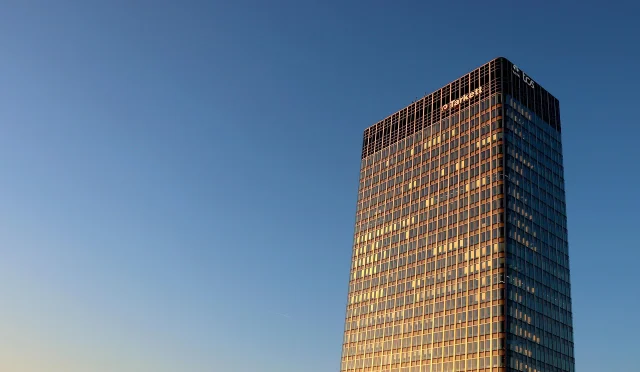
La Défense business district in Paris, where Vivendi's financial collapse reverberated through French banking
La Défense, Paris — BNP Paribas and other French banks held Vivendi's €35 billion debt, giving them quiet veto power over the CEO transition 10
Messier's exit package was reported at approximately $20 million. 4 The SEC later required him to forfeit approximately €21 million in severance and pay a $1 million civil penalty as part of the fraud settlement.
Jean-René Fourtou was confirmed as CEO on July 4. His first communication to employees acknowledged that resolving "our company's short-term liquidity problems" was his only priority. 2 His private assessment — disclosed later in a French parliamentary hearing — was more precise: had Messier remained in place after July 3, the company would have been bankrupt within 10 days. 3

Within a week of the coup, seven international banks provided a €1 billion emergency credit line. By September 18, a syndicate of 11 banks had agreed to a €3 billion medium-term facility (secured, in three tranches, due November 2003–December 2004), buying the time needed to sell assets. 9
On September 25, 2002, Fourtou announced the restructuring plan: €12 billion in asset sales within 18 months (€5 billion within nine months). The entertainment core — Universal Music, Universal Studios, theme parks, and video games — would be retained. Canal+'s international operations, Vivendi Universal Publishing, internet assets, and non-core telecom stakes were to go. 9
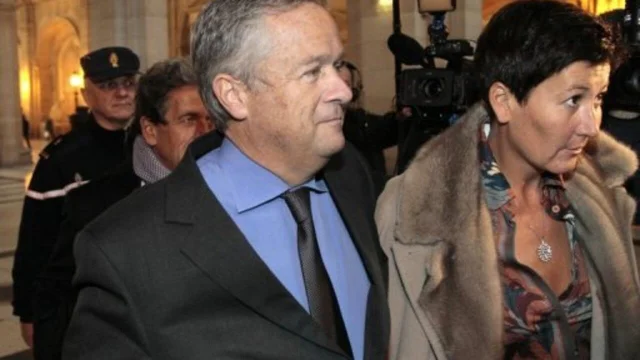
Jean-Marie Messier arrives at Paris court for trial, January 2011
Messier arriving at Paris criminal court on January 21, 2011 — convicted that day of misuse of corporate assets 14
In March 2003, Vivendi reported a 2002 net loss of €23.3 billion — the largest annual loss in French corporate history, exceeding France Télécom's €20.7 billion loss reported the previous day. The figure was mostly goodwill write-downs on assets Messier had overpaid for. By late 2003, Fourtou had reduced debt from its €35 billion peak to approximately €5 billion — a restructuring completed in roughly 18 months.
The legal proceedings ran for 15 more years:
  • December 2003: The SEC settled civil fraud charges against Vivendi ($50M), Messier ($1M penalty plus forfeiture of €21M in severance), and Hannezo ($148,149 disgorgement plus $120,000 penalty). Both men accepted five- and ten-year bans on serving as officers or directors of public companies. 13
  • January 2010: A Manhattan jury found Vivendi liable on all 57 alleged misrepresentations under Section 10(b). Individual damages were estimated at up to $9.3 billion. 15
  • June 2010: The U.S. Supreme Court's ruling in Morrison v. National Australia Bank (561 U.S. 247) established that Section 10(b) applies only to securities traded on U.S. exchanges or transactions completed in the United States. The decision eliminated the claims of foreign investors who had purchased Vivendi's Paris-listed ordinary shares. Vivendi stated this removed more than 80% of its potential damages exposure. 16
  • January 2011: A Paris criminal court convicted Messier of disseminating false or misleading information and misuse of corporate assets, sentencing him to three years' suspended imprisonment and a €150,000 fine. The appeals court reduced the sentence in 2014 to 10 months' suspension and €50,000 after overturning the misleading-information conviction — but upheld the misuse-of-assets charge. 17
  • April 2017: The U.S. class action settled for $26.4 million — 0.28% of the $9.3 billion jury verdict. Total payments by Vivendi across all U.S. proceedings: approximately $78 million. 18

Frameworks you can use

Roll's hubris hypothesis: why overpaying is the default, not the exception

Richard Roll's 1986 paper in the Journal of Business ("The Hubris Hypothesis of Corporate Takeovers") proposed a mechanism that looks obvious in retrospect but was largely ignored in real-time Vivendi coverage: managers systematically overestimate their ability to create value, causing them to pay premiums that cannot be justified by any realistic synergy estimate. The acquirer's stock typically falls on announcement — the market prices in the hubris — while the target's stock rises. Shareholders in the acquiring company are subsidizing a bet on management's self-belief.
Messier's acquisition sequence fits the Roll pattern almost mechanically. The $34 billion Seagram deal closed in December 2000 — the month the dot-com bubble definitively burst, destroying the "content-on-all-devices" thesis that had justified the price. The $2.2 billion Houghton Mifflin deal was criticized by analysts at announcement as having zero synergies with the core entertainment assets. Albarran and Gormly's 2004 academic comparison of AOL-Time Warner and Vivendi Universal concluded that both mega-mergers "were the result of both hubris and a failed vision" — and noted that Vivendi's stock had fallen more than 70% from its pre-Seagram high, with cumulative debt reaching $29 billion. 19
Transfer: The Roll framework suggests a single diagnostic question before any premium acquisition: if the synergy projections were stripped out and the deal were evaluated purely on the target's standalone value, does the price still make sense? CEOs who cannot answer "yes" to that question are funding their own obituary. Cross-validating synergy estimates against the market's immediate reaction to the announcement is a cheap sanity check that most boards skip.

Overleverage fragility: the debt threshold past which recovery becomes impossible

Vivendi's collapse was not caused by its operating businesses. Universal Music, Universal Studios, and Canal+ were all generating cash — imperfectly, unevenly, but generating it. The collapse was caused by the leverage ratio relative to free cash flow and asset liquidity. At €35 billion in debt with €7.5 billion due within 12 months and only €2.3 billion in accessible credit, the company had crossed into a zone where it could not service obligations from operations and could not refinance because the market had lost confidence in Messier's numbers. 10
The mechanism is standard: debt forces asset sales → distressed-sale prices destroy equity value → debt-to-equity ratio worsens → credit rating falls → borrowing costs spike → more debt needed to roll existing obligations → repeat. Vivendi never got past the first cycle. Fourtou stopped the spiral by restoring creditor confidence through management change before the first covenants triggered.
Transfer: The actionable threshold for deal-makers is not the absolute debt level but the ratio of near-term maturities to accessible liquidity under a stressed scenario. Vivendi's stress scenario — credit lines unavailable because banks were waiting for a management change — was not implausible; it was precisely what happened. When modeling deal financing, map the scenario in which your main lending banks lose confidence in management. If that scenario produces insolvency within 90 days, the capital structure needs more cushion.

Boardroom coup mechanics: from enabler to executioner

Chabrak, Craig and Daidj's 2016 analysis in Leadership (SAGE) identified three elite factions inside Vivendi: the "nouveau riche" (Messier and allies), the "old guard" (traditional French establishment), and the "established elite" (the broker class, exemplified by Bébéar). The coup followed a distinct choreography that appears in other French and European corporate governance crises.
Stage 1 — public signal: Bébéar's radio interview broke the silence norm and established that a majority of the establishment had concluded Messier was unacceptable. This is necessary before any French board member will commit to the losing side of a contested vote. Stage 2 — private lobbying: Bébéar worked French directors individually, converting them from abstention to active opposition. Stage 3 — coalition lock: Arnault's board resignation one week before the vote removed Messier's most prominent French supporter and made the vote's outcome certain. Stage 4 — creditor coordination: Banks signaled they would restore credit lines once management changed — this flipped the company's BATNA, because Messier could no longer credibly threaten "I'll negotiate directly with creditors" if creditors were waiting for his removal. Stage 5 — ultimatum: The Bronfmans delivered a weekend demand with a Monday deadline. Messier's only remaining option was to negotiate departure terms.
Transfer: Directors facing a similar situation — a CEO who has lost market credibility but retains formal authority — should note that the sequence matters. Public signals alone do not remove CEOs; neither does private lobbying without external pressure. The combination of public credibility withdrawal (rating downgrades, analyst commentary, institutional investor statements), private coalition building, and a coordinated creditor position is what makes the ultimatum credible. Any single element, deployed alone, fails.

The negotiauction: selling assets under liquidity duress

Harvard's Program on Negotiation analyzed Fourtou's 2003 sale of Universal Entertainment to GE as a textbook "negotiauction" — a hybrid of competitive bidding and bilateral negotiation, where the seller deliberately keeps the rules vague to maximize both competitive pressure and flexibility. 20
Five bidders entered: MGM, GE/NBC, Viacom, Liberty Media, and a consortium led by Marvin Davis and Edgar Bronfman Jr. MGM initially led at $11.5 billion. Messier's successor (Fourtou) set a hard closing deadline — then allowed GE to submit hours late and Viacom days late. MGM, attempting to use its lead position as leverage to demand exclusive data access, was told no and withdrew. GE ultimately won at $14 billion in GE stock. The seller captured $2.5 billion more than the initial highest bid by keeping the process structure fluid.
Transfer: When selling an asset under duress, the instinct is to accept the first offer above your reservation price and close before conditions deteriorate further. The Vivendi case argues for a different approach: maintain enough bidder optionality to allow late entrants, because the threat of a new bidder is often more valuable than the bid itself. The key constraint is that the seller must have enough liquidity runway to sustain a multi-round process. Fourtou had secured the €3 billion bank facility before beginning the entertainment sale, which is what made the negotiauction viable.

What to remember

  • Debt trajectory matters more than debt level. Vivendi's €3 billion in debt in 1999 was unremarkable. Its €35 billion in mid-2002 was fatal — not because the number was abstract, but because €7.5 billion was due within 12 months and only €2.3 billion was accessible. Directors approving acquisition financing should stress-test near-term maturities against a scenario in which banks pause credit lines pending management review. That scenario is not hypothetical; it is what happened here.
  • The PDG's organizational void cuts both ways. Messier exploited the French PDG governance norm — the absence of formal checks on a dominant chief executive — to accumulate power without dissent. The same norm made his removal swift once the elite consensus shifted: there were no procedural protections, no poison pill, no supermajority requirement. Governance structures that concentrate authority in a single person accelerate both rises and falls.
  • Concealing a cash crisis extends it and worsens it. The SEC complaint documents that Messier and Hannezo continued issuing "outstanding liquidity" statements while the company was structurally unable to access the cash generated by its own subsidiaries. The concealment bought weeks and cost billions — because investors and creditors who might have pressured earlier restructuring were working from false numbers. Transparency at the first sign of structural liquidity constraints is cheaper than the alternative.
  • Morrison v. National Australia Bank is the outcome that most deal lawyers remember. What began as a $9.3 billion jury verdict — potentially the largest securities class-action award in U.S. history — settled for $26.4 million, largely because the Supreme Court's 2010 ruling eliminated the claims of investors who had purchased ordinary shares on the Paris Bourse. For non-U.S. issuers with dual-listed securities, the case is a reminder that U.S. securities-law exposure runs primarily through the exchange-listed instrument (here, ADRs), not the home-market shares. The architecture of cross-listing decisions should account for this asymmetry.
Loading link preview…
Cover image: Jean-Marie Messier at a Vivendi Universal event, circa 2001. Image via The Guardian.

Related content

Add more perspectives or context around this Post.

  • Sign in to comment.