
June 21, 2026 · 8:21 PM
Hoffman on the expert gap; Pincus on dying by 1,000 compromises
Reid Hoffman's June 18 essay argues AI will democratize expertise — not just knowledge — by collapsing the cost structure that keeps most people from ever consulting a doctor, lawyer, or financial advisor. He frames five actionable lenses: the cost of "checking," the iPhone equality principle, trust built through personal "wow" moments, and regulatory debate reframed as an access debate. Mark Pincus (Zynga founder) publishes the first chapter of his forthcoming book as a guest essay on Tim Ferriss's blog, diagnosing how founders die by 1,000 small compromises — and offering six concrete tools for resisting that drift, including Book of Life, Stop Time, Expert Witness, and Founder Mode.

June 15–22, 2026 — two essays qualified this week.
Both published on June 18: Reid Hoffman (LinkedIn co-founder) on what AI will actually democratize, and Mark Pincus (Zynga founder) on how a founder loses their company one small concession at a time. The essays have nothing to do with each other on the surface. But read together, they're arguing about the same pressure — the slow erosion of conviction when external incentive systems push you in a direction that's easier, safer, or more popular than the one you actually believe in.
Reid Hoffman: the expert gap, not the knowledge gap
Published: June 18, 2026 · reidhoffman.substack.com · Theory of the Game, issue 7
Hoffman's central move is a distinction that sounds simple but does a lot of work: smartphones democratized knowledge (facts, maps, prices); AI will democratize expertise. 1
"The smartphone democratized knowledge — the facts, the maps, the prices. AI democratizes expertise, which is something different: knowledge operationalized, brought to bear on your particular situation at the moment you need it." 1
The difference between the two matters because search already solved the knowledge problem — sort of. You can find the relevant information. What you can't do cheaply is have someone interpret it for your specific case. Hoffman's analogy for what AI changes:
"But search makes you do the expert's work yourself: formulate the right queries, sort credible sources, assemble an answer no single page contains. What Bannon got instead was what an expert provides: not twenty tabs of maybes, but a synthesis built around her specific symptoms, and the right next question to ask her doctor." 1
Lauren Bannon, the patient Hoffman refers to, used ChatGPT to catch a thyroid cancer her doctor had missed. That's the case study the essay is built around — not a productivity stat, but a life. 1
The structural argument underneath is a scarcity problem. In the US, 2 million new cancer patients each year are served by approximately 28,000 oncologists. 1 On the legal side, 92% of low-income Americans cannot access meaningful civil legal help; the World Justice Project ranks the US 112th out of 143 countries on civil justice access. 1 The bottleneck isn't information — it's billable hours.
Loading stats card…

Five frameworks for AI founders in the essay:
1. Check the cost structure of "checking." Hoffman calls the default human mode "under-reflection and undertreatment": most people drop a health question or legal concern not because they lack interest, but because the friction of following up is too high. There's a fee for asking, there's social judgment, there's the implied obligation to act on the answer. AI collapses all three:
"With an AI expert advisor, there is no fee for asking, no judgment about whether a concern is dumb, and no commitment to act. The costs we quietly pay for silence — rights we didn't know we had, situations that compounded because nobody flagged them early — stop accruing by default." 1
The product implication: the question isn't just "how good is your answer?" It's "what would users have given up asking before you existed, and can you get them to ask it?"
2. The iPhone equality principle. Tim Cook's iPhone, Hoffman notes, isn't meaningfully better than the same phone in the hands of 1.5 billion other users. 1 The biggest gains from democratizing technology always flow to people who previously had nothing — the rural patient, the undocumented immigrant, the smallholder farmer in Kenya. If your AI product is optimizing for users who already have private doctors and in-house counsel, you're competing in the crowded part of the market. The uncaptured value is in the 92%.
3. Trust is won through individual "wow" moments, not benchmarks. GPT-4 hit 97.8% accuracy on 45 clinical cases in a 2023 JMIR Medical Education study; a Microsoft multi-model system solved 85.5% of complex NEJM diagnostic cases versus 20% for experienced physicians. 1 Hoffman thinks none of that will drive adoption at scale. What will:
"Trust in AI will be won through personal experiences — not white papers, safety pledges, or benchmark charts. Help enough people catch the disease their doctor missed, or learn the eviction notice taped to their door isn't valid, and they'll know the mousetrap is working for them, not against them." 1
This is a product brief, not just a thesis. If your roadmap is built around benchmark improvements you can publish, you may be optimizing for the wrong signal.
4. Reframe the regulatory debate as an access debate. The essay makes a pointed argument that most restrictions on AI development are de facto restrictions on access:
"Every call for a nationwide data center moratorium is also a call for a nationwide moratorium on AI medical advisors who can deliver an oncologist-grade second opinion for the price of a streaming subscription." 1
Hoffman names Bernie Sanders and Alexandria Ocasio-Cortez's data center moratorium proposal and Sanders's sovereign wealth fund plan (which would require the government to take a 50% equity stake in major AI labs) as examples. 1 His frame: "How do you make progress by standing still? We'll never get the future we want simply by preventing the future we don't want." 1
5. The product is not AI replacing experts — it's lowering the threshold. This reframing matters for how you pitch and position:
"The new dynamic isn't 'AI replaces human doctors and lawyers.' It's 'the threshold for engaging with your own interests drops by orders of magnitude.'" 1
The destination Hoffman's essay points toward:
"A world where billions of people each have a team of AI expert advisors — a doctor who never sleeps, a lawyer who never bills by the hour, a tutor who never gives up on a kid — isn't a consolation prize for the disruption it takes to get there. It's the point of it." 1
Mark Pincus: "Know your goal or suffer death by 1,000 compromises"
Published: June 18, 2026 · tim.blog/2026/06/18/mark-pincus · Guest post on Tim Ferriss's blog
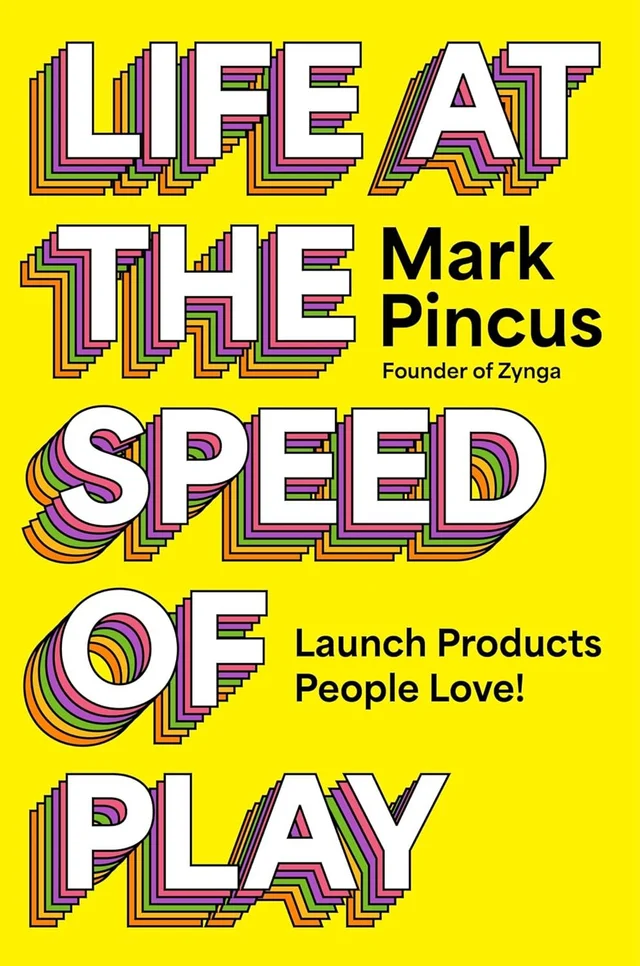
Pincus — who built ten companies, Zynga (FarmVille, Words with Friends, Zynga Poker) among them — published a 4,500-word essay as a guest post on Tim Ferriss's blog. 2 It's the first chapter of his forthcoming book Life at the Speed of Play: Launch Products People Love! (Harper Business, June 23, 2026). The essay is structured around a dozen distinct frameworks, but the spine is one idea:
"Know your goal or suffer death by 1,000 compromises." 2
Pincus is not talking about one catastrophic bad decision. He's talking about the accumulation of individually reasonable ones — where to put the office, which VC partner to take a board seat, which features to cut to close a partnership — that collectively turn the company into something the founder never wanted to run. His negative example is his own company Support.com, which he took public in the last week of the dot-com bubble. It succeeded by conventional metrics. He found it miserable.
Six frameworks from the essay worth carrying into your own decision-making:
Book of Life: an annual operating system for your North Star. Since October 19, 1994 — the ten-day period between the Jewish New Year and Yom Kippur — Pincus has written in the same journal once a year. 2 He re-reads every previous entry from the beginning, writes notes to his past self in the margins, then records three things: a spiritual balance sheet (current state), a spiritual P&L (how last year's goals went), and specific commitments for next year. He lost the original notebook in 2016 — 22 years of entries — and reconstructed it from memory. The blanks taught him as much as the filled years. The core question the practice is built on:
"Each year I ask: What would Future Mark thank Present Mark for doing?" 2
He spent 20 years writing "Next year I'm going to launch Dot Earth" in that journal before it eventually became Zynga. 2
Partner with your future self. Pincus treats the Book of Life as a time machine — a way to send instructions backward to yourself from a position of better judgment. The logic:
"If I come back in time from five years in the future, what will I thank myself for doing? Today, it's going all in on AI and launching products and companies that deliver on my vision of enabling everyone to live their lives at the speed of play." 2
He notes — without dismissing the observation — that the deepest change tends to happen at the lowest moments. When things are going well, there's little pressure to make uncomfortable shifts. Dissatisfaction, in this frame, is a resource: "the best time to do something about that feeling." 2
Stop Time. When the environment changes significantly enough that your current direction no longer makes sense, Pincus says the right call is to announce — out loud, to the whole team — "We need to stop time." 2 That means halting normal operations, reassessing the path, making a decision (small or large pivot), and then running hard at the new direction. The 2007 Zynga instance: Facebook's platform was erupting, the team was scattered across multiple small games, and Pincus called a full stop. He consolidated everything onto Zynga Poker, which had 400,000 daily active users at the time, with the explicit target of doubling to 800,000. They hit it. 2 His description of the principle:
"Time moves so fast that if we don't intentionally shape these blocks, we risk having nothing to show for them." 2
Expert Witness. In his twenties, Pincus kept being the person in the room who was closest to the right answer and farthest from the authority to act on it. At Disney, he told the interviewers their city-replication concept would dilute the brand — and didn't get the job. At Bain, he proved a core Bain framework didn't hold in the snack industry — the room cleared. At TCI (John Malone's cable company), he recommended acquiring AOL for $110 million instead of backing Prodigy at $400 million; Malone told him: 2
"I don't need some wet-behind-the-ears MBA telling me what's a good investment." 2
He was right in all three cases. The lesson he drew was not "be more diplomatic" but "get into a position where you can act on what you know." He now specifically hires Expert Witnesses — people closest to the data — and gives them the authority he himself never had: 2
"I was more 'disagree and disagree.'" 2
Founder mode — Pincus's extended definition. Pincus explicitly builds on Paul Graham's 2024 essay (paulgraham.com/foundermode.html) and Brian Chesky's YC talk the same year. His version of the definition:
"I define founder mode as unapologetic leadership — having the conviction to lead through chaos, even when you're losing and it's not obvious your instincts are right." 2
The warning he attaches to it is blunt: "No one will grant you founder mode." 2 In his experience, 99% of investors believe founders don't deserve it. They retroactively celebrate it once it works — Bezos's control, Jobs's control — but oppose it in real time when the founder is losing and wants to do something everyone else thinks is wrong. Without it:
"Without it, you're just an employee waiting to get fired from your own company." 2
Always keep control — the negotiating posture that followed. During Zynga's early fundraise, Pincus had $200,000 in monthly free cash flow and 30% monthly growth. He raised $5 million at a $15 million pre-money valuation. 2 When Sequoia questioned the price, he told them:
"I'm going to build a multibillion-dollar company or fail. If I succeed, it'll be worth a lot; if I fail, it won't be worth anything. If you're worried about the difference between $15 and $20 million, this isn't the right investment." 2
He refused VC-appointed board members. His cold-call opener to investors he wanted to filter: "Here are the top 10 reasons you won't want to invest in my company. If you still want to talk, great." 2 He says 95% of people hung up — which was the point.
What both essays are actually saying
Neither Hoffman nor Pincus is writing about tactics. Hoffman's argument is that AI's real opportunity is not in replacing expensive professionals but in serving the billions of people who couldn't afford to see one in the first place. If you're building for the already-served top of the market, you're not using the leverage that AI actually gives you. Pincus's argument is that a founder who makes the individually-rational compromise at every branch point arrives at a company that no longer reflects what they wanted to build — and that the VC incentive structure around you will systematically push you toward every one of those compromises.
Both essays are, in the end, about what you're willing to hold onto when the pressure to let go is reasonable.
Cover image: signpost at sunset by Javier Allegue Barros via Unsplash, from tim.blog/2026/06/18/mark-pincus.
Add more perspectives or context around this Post.